
Witton Cemetery
Witton, Metropolitan Borough of Birmingham, West Midlands, England
About
-
Get directions Moor Lane
Witton, Metropolitan Borough of Birmingham, West Midlands B6 7AE EnglandCoordinates: 52.52652, -1.88279 - www.birmingham.gov.uk/xfp/form/1046
- 0121 216 2000
-
Office Address
Sutton New Hall Cemetery
Lindridge Road
Sutton Coldfield
Birmingham
B75 7HX - Cemetery ID:
-
Additional information
FREE OF CHARGE: Grave location, provided a full name and date (or year) of death is given.
SEARCH 1 within one year of approximate year of death up to three names. Register information included. £10.00
SEARCH 2 within two years of approximate date of death up to two names. Register Information included. £10.00
SEARCH 3 within three years of approximate date of death one name only. Register Information included. £10.00
Members have Contributed
Photos


The land for the cemetery was purchased from Wyrley Birch esq in 1860. The site was 105 acres, although it was the initial plan was to only use 60 acres.
The buildings were designed by Architect R Clark of Nottingham and the Grounds by R Ashwell of Coventry.
Although the cemetery opened in May 1863, the first burial was on 27th August 1861. Mary Sturge was the wife of Charles Sturge who was the Mayor of Birmingham at that time, an Alderman, and a prominent member of the Society of Friends and he was given special permission to have his wife buried there. Mary and Charles's grave had a simple plaque on the ground, but the ground has since claimed it.
The north half of the cemetery was not consecrated and was mainly used to bury people of non-conformist religions and people of the Catholic/Roman Catholic faith.
When the cemetery was laid out it was planned to build a chapel for the non-conformists (called the Dissenters chapel) and a chapel for the Church of England half of the cemetery (called the Episcopal chapel), which would be both funded by the government.
There was permission given for a Roman Catholic chapel, but funding was not given by the government for that and the Catholic community were expected to get funding for that. After a lot of public protests, the government finally agreed to fund and build a further chapel for the Catholic faith.
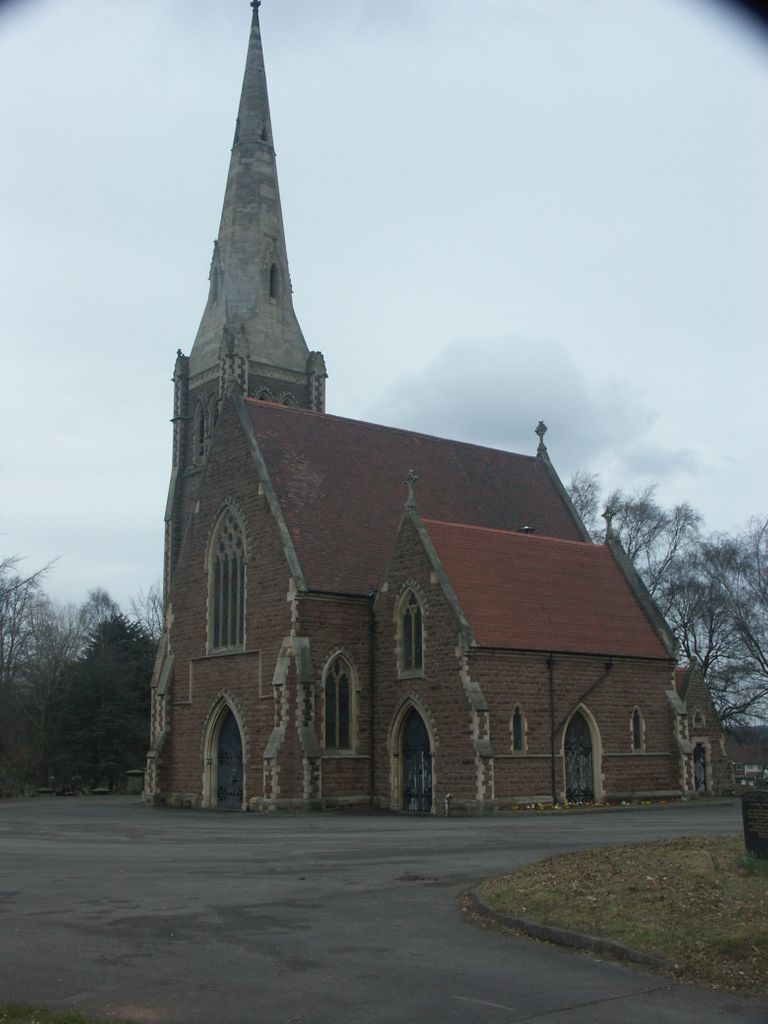
Both the Catholic chapel and the Dissenters chapels were demolished in the 1950's. The Episcopal chapel remains, but it is no longer in use.
The cemetery includes the re-interred remains of those who were buried at:
Cannon Street Chapel Chapelyard
Chequers Walk Jewish Burial Ground (1876)
Ebenezer Congregational Chapel Chapelyard, Steelhouse Lane (1887 and 1931)
Old Meeting House, Philip Street (1882)
Park Street Burial Ground (an extension to St Martin's) (1882)
Zion Chapel Chapelyard (ex Baptist, ex Swedenborgian) (1903)
St Mary's chapel, Whittall Street
During the first 10 years, most graves were only allowed two burials in them, and these could often be public burials so both people might not have been related.
It later became allowed for people to purchase those graves and to use them then as private graves, which is why there are often empty sections with a few headstones in them. This might have been a cheaper option to have a family grave in those areas rather than buying a family grave in a section reserved for all private burials.
After then, most graves were used as unmarked graves until about WW2 for common/public burials, and had about 4-6 burials in each grave of people who all died around the same time, except for the sections on either side of the main avenue and near the chapels.
It was normal practice to reuse unmarked public graves after about 30 years, and this happened with some unmarked Private graves too if they were not maintained.
After WW2, over half of the old public graves were reused for private burials.
The land for the cemetery was purchased from Wyrley Birch esq in 1860. The site was 105 acres, although it was the initial plan was to only use 60 acres.
The buildings were designed by Architect R Clark of Nottingham and the Grounds by R Ashwell of Coventry.
Although the cemetery opened in May 1863, the first burial was on 27th August 1861. Mary Sturge was the wife of Charles Sturge who was the Mayor of Birmingham at that time, an Alderman, and a prominent member of the Society of Friends and he was given special permission to have his wife buried there. Mary and Charles's grave had a simple plaque on the ground, but the ground has since claimed it.
The north half of the cemetery was not consecrated and was mainly used to bury people of non-conformist religions and people of the Catholic/Roman Catholic faith.
When the cemetery was laid out it was planned to build a chapel for the non-conformists (called the Dissenters chapel) and a chapel for the Church of England half of the cemetery (called the Episcopal chapel), which would be both funded by the government.
There was permission given for a Roman Catholic chapel, but funding was not given by the government for that and the Catholic community were expected to get funding for that. After a lot of public protests, the government finally agreed to fund and build a further chapel for the Catholic faith.
Both the Catholic chapel and the Dissenters chapels were demolished in the 1950's. The Episcopal chapel remains, but it is no longer in use.
The cemetery includes the re-interred remains of those who were buried at:
Cannon Street Chapel Chapelyard
Chequers Walk Jewish Burial Ground (1876)
Ebenezer Congregational Chapel Chapelyard, Steelhouse Lane (1887 and 1931)
Old Meeting House, Philip Street (1882)
Park Street Burial Ground (an extension to St Martin's) (1882)
Zion Chapel Chapelyard (ex Baptist, ex Swedenborgian) (1903)
St Mary's chapel, Whittall Street
During the first 10 years, most graves were only allowed two burials in them, and these could often be public burials so both people might not have been related.
It later became allowed for people to purchase those graves and to use them then as private graves, which is why there are often empty sections with a few headstones in them. This might have been a cheaper option to have a family grave in those areas rather than buying a family grave in a section reserved for all private burials.
After then, most graves were used as unmarked graves until about WW2 for common/public burials, and had about 4-6 burials in each grave of people who all died around the same time, except for the sections on either side of the main avenue and near the chapels.
It was normal practice to reuse unmarked public graves after about 30 years, and this happened with some unmarked Private graves too if they were not maintained.
After WW2, over half of the old public graves were reused for private burials.
Nearby cemeteries

Witton, Metropolitan Borough of Birmingham, West Midlands, England
- 1k+
- 99%
- 0%

Birmingham, Metropolitan Borough of Birmingham, West Midlands, England
- 598
- 93%
- 1%

Perry Barr, Metropolitan Borough of Birmingham, West Midlands, England
- 132
- 82%
- 11%

- Added: 2 Jan 2007
- Find a Grave Cemetery ID: 2201852

Cemetery Photos
This is a carousel with slides. Use Next and Previous buttons to navigate, or jump to a slide with the slide dots. Use Escape keyboard button or the Close button to close the carousel.


Success
Uploading...
Waiting...
Failed
This photo was not uploaded because this cemetery already has 20 photos
This photo was not uploaded because you have already uploaded 5 photos to this cemetery
This photo was not uploaded because you have already uploaded 5 photos to this cemetery
Invalid File Type
Birth and death years unknown.
1 photo picked...
2 photos picked...
Uploading 1 Photo
Uploading 2 Photos
1 Photo Uploaded
2 Photos Uploaded
This photo is larger than 20 MB. Please resize to less than 20 MB and try again.
Too many photos have been uploaded
"Unsupported file type"
• ##count## of 0 memorials with GPS displayed. Double click on map to view more.No cemeteries found