
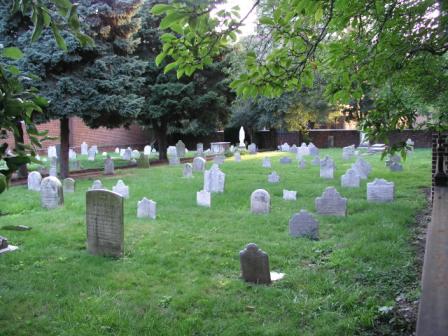
Old Saint Mary's Roman Catholic Churchyard
Also known as Old Saint Mary Cemetery, St. Mary's Graveyard
Philadelphia, Philadelphia County, Pennsylvania, USA
About
-
Get directions 248 S. 4th Street between Spruce and Walnut
Philadelphia, Pennsylvania 19106-3722 United StatesCoordinates: 39.94575, -75.14893 - 215-923-7930
- Cemetery ID:
Members have Contributed
Photos


As one of the oldest Catholic graveyards in the country, St. Mary's is most closely connected with early American Catholic history.
Its history also is closely tied to that of Philadelphia's St. Joseph's Church and graveyard, which is the earliest burial ground in Philadelphia. Mass at St. Joseph's was first celebrated in 1732, and in keeping with old customs, its churchyard became the burial ground for its deceased members. Enlargements to the church building encroached more and more on the small area for burials, so in 1758 St. Joseph's began taking subscriptions for a new cemetery. Ground was purchased in 1759, intended solely for a cemetery for St. Joseph's.
But in 1760 Father Robert Harding began plans for a new larger church and cemetery, which he intended to occupy the newly acquired lot for St. Joseph's cemetery, and would become St. Mary's.
This property had a front on Fourth Street of 63 feet and a depth of 396 feet. St. Mary's burial ground does not appear to have had a name until the church was built, and burials were made in the Fourth Street ground 4 years before the church was built. The first burial was for Ann White, who died a few months after her birth in February 1759.
The new ground seemed large enough to serve the needs for St. Mary's cemetery for many years, and in 1803 part of the ground, on the Fifth Street end of the lot, was sold to Holy Trinity Church, which stood at the northwest corner of Sixth and Spruce streets. Holy Trinity had had a burial ground connected with their church from the time it was built in 1789, but they too needed to increase its size. Holy Trinity already had acquired a strip along the south side of the lot from St. Mary's.
Yellow fever epidemics in the 1790s put strains of all of Philadelphia's cemeteries. In the yellow fever epidemic of late summer and early autumn 1793, Philadelphia had only 2 Catholic burial grounds: the churchyard of Holy Trinity Church and the cemetery at St. Mary's. During the 4 months of the plague, 335 interments were made in these 2 cemeteries, nearly all of them yellow fever victims. During the epidemic in 1797, 89 burials were made in St. Mary's cemetery, and in the 1798 epidemic, 237 interments were made in St. Mary's.
In 1800 St. Mary's trustees planned for the future by purchasing a small lot on the west side of Thirteenth Street, below Spruce, to also be used for burials.
After the Rt. Rev. Henry Conwell, D.D., in Ireland, was appointed Bishop of the Diocese in 1820, he made his home at St. Joseph's, and attempted to iron out past difficulties between St. Mary's and St. Joseph's, but his first attempts were unsuccessful. Since he couldn't occupy St. Mary's Church as his Cathedral, and since St. Mary's cemetery was closed to his adherents by their trustees, Rome advised him to build a Cathedral of his own. Thus, he again enlarged St. Joseph's Church, which still had its graveyard. Searching for a new cemetery to re-inter the bodies at St. Joseph's, Bishop Conwell found a lot, on which St. Mary's trustees had an option.
In 1824 St. Mary's trustees received a complaint from the Board of Health, concerning "the mode of interment" (overcrowding) followed with the cemetery on Thirteenth Street, below Spruce. This small graveyard previously was on the west side of Thirteenth Street, a little south of Budd Street. The trustees then procured an option on an irregularly shaped piece of ground at the corner of Washington and Passyunk avenues; however, they were in debt and were not financially able to buy anything. So they transferred their option to Bishop Conwell.
In the meantime, St. Mary's trustees acquired new ground for a cemetery in April 1835. This plot, about 5 acres, was originally on Buck Road in Moyamensing Township. The ground was blessed on June 21, 1835, and was called St. Mary's Moyamensing Cemetery. When it was opened the burial ground on Thirteenth Street, south of Spruce, was closed to interment. The Moyamensing lot became much dissected as the city cut streets through it. A small section of St. Mary's Cemetery remained at Tenth and Moore Streets.
Owing to the ravages of time, many tombstones and consequently many records of St. Mary's graveyard are lost.
—This information is summarized from Joseph Jackson, "Catholic Burial Grounds in Philadelphia," Records of the American Catholic Historical Society, Vol. LVI, No. 2 (June 1945), pp. 69-81.
As one of the oldest Catholic graveyards in the country, St. Mary's is most closely connected with early American Catholic history.
Its history also is closely tied to that of Philadelphia's St. Joseph's Church and graveyard, which is the earliest burial ground in Philadelphia. Mass at St. Joseph's was first celebrated in 1732, and in keeping with old customs, its churchyard became the burial ground for its deceased members. Enlargements to the church building encroached more and more on the small area for burials, so in 1758 St. Joseph's began taking subscriptions for a new cemetery. Ground was purchased in 1759, intended solely for a cemetery for St. Joseph's.
But in 1760 Father Robert Harding began plans for a new larger church and cemetery, which he intended to occupy the newly acquired lot for St. Joseph's cemetery, and would become St. Mary's.
This property had a front on Fourth Street of 63 feet and a depth of 396 feet. St. Mary's burial ground does not appear to have had a name until the church was built, and burials were made in the Fourth Street ground 4 years before the church was built. The first burial was for Ann White, who died a few months after her birth in February 1759.
The new ground seemed large enough to serve the needs for St. Mary's cemetery for many years, and in 1803 part of the ground, on the Fifth Street end of the lot, was sold to Holy Trinity Church, which stood at the northwest corner of Sixth and Spruce streets. Holy Trinity had had a burial ground connected with their church from the time it was built in 1789, but they too needed to increase its size. Holy Trinity already had acquired a strip along the south side of the lot from St. Mary's.
Yellow fever epidemics in the 1790s put strains of all of Philadelphia's cemeteries. In the yellow fever epidemic of late summer and early autumn 1793, Philadelphia had only 2 Catholic burial grounds: the churchyard of Holy Trinity Church and the cemetery at St. Mary's. During the 4 months of the plague, 335 interments were made in these 2 cemeteries, nearly all of them yellow fever victims. During the epidemic in 1797, 89 burials were made in St. Mary's cemetery, and in the 1798 epidemic, 237 interments were made in St. Mary's.
In 1800 St. Mary's trustees planned for the future by purchasing a small lot on the west side of Thirteenth Street, below Spruce, to also be used for burials.
After the Rt. Rev. Henry Conwell, D.D., in Ireland, was appointed Bishop of the Diocese in 1820, he made his home at St. Joseph's, and attempted to iron out past difficulties between St. Mary's and St. Joseph's, but his first attempts were unsuccessful. Since he couldn't occupy St. Mary's Church as his Cathedral, and since St. Mary's cemetery was closed to his adherents by their trustees, Rome advised him to build a Cathedral of his own. Thus, he again enlarged St. Joseph's Church, which still had its graveyard. Searching for a new cemetery to re-inter the bodies at St. Joseph's, Bishop Conwell found a lot, on which St. Mary's trustees had an option.
In 1824 St. Mary's trustees received a complaint from the Board of Health, concerning "the mode of interment" (overcrowding) followed with the cemetery on Thirteenth Street, below Spruce. This small graveyard previously was on the west side of Thirteenth Street, a little south of Budd Street. The trustees then procured an option on an irregularly shaped piece of ground at the corner of Washington and Passyunk avenues; however, they were in debt and were not financially able to buy anything. So they transferred their option to Bishop Conwell.
In the meantime, St. Mary's trustees acquired new ground for a cemetery in April 1835. This plot, about 5 acres, was originally on Buck Road in Moyamensing Township. The ground was blessed on June 21, 1835, and was called St. Mary's Moyamensing Cemetery. When it was opened the burial ground on Thirteenth Street, south of Spruce, was closed to interment. The Moyamensing lot became much dissected as the city cut streets through it. A small section of St. Mary's Cemetery remained at Tenth and Moore Streets.
Owing to the ravages of time, many tombstones and consequently many records of St. Mary's graveyard are lost.
—This information is summarized from Joseph Jackson, "Catholic Burial Grounds in Philadelphia," Records of the American Catholic Historical Society, Vol. LVI, No. 2 (June 1945), pp. 69-81.
Nearby cemeteries


Philadelphia, Philadelphia County, Pennsylvania, USA
- 94
- 2%
- 0%

Philadelphia, Philadelphia County, Pennsylvania, USA
- 30
- 0%
- 0%
- Added: 1 Jan 2000
- Find a Grave Cemetery ID: 46129

Cemetery Photos
This is a carousel with slides. Use Next and Previous buttons to navigate, or jump to a slide with the slide dots. Use Escape keyboard button or the Close button to close the carousel.


Success
Uploading...
Waiting...
Failed
This photo was not uploaded because this cemetery already has 20 photos
This photo was not uploaded because you have already uploaded 5 photos to this cemetery
This photo was not uploaded because you have already uploaded 5 photos to this cemetery
Invalid File Type
Birth and death years unknown.
1 photo picked...
2 photos picked...
Uploading 1 Photo
Uploading 2 Photos
1 Photo Uploaded
2 Photos Uploaded
This photo is larger than 20 MB. Please resize to less than 20 MB and try again.
Too many photos have been uploaded
"Unsupported file type"
• ##count## of 0 memorials with GPS displayed. Double click on map to view more.No cemeteries found