
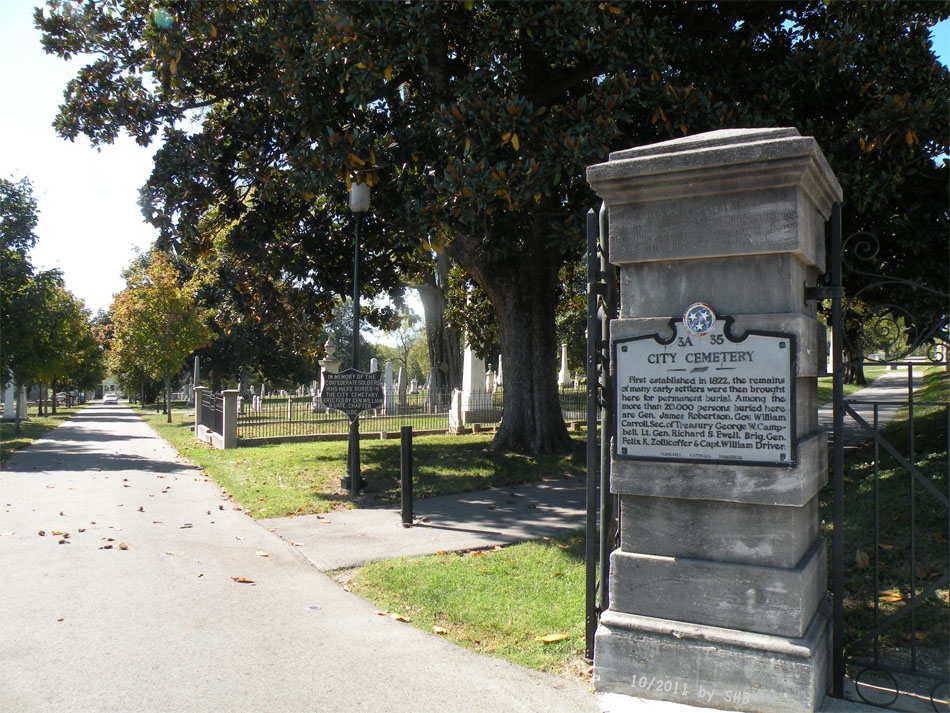
Nashville City Cemetery
Also known as City Cemetery
Nashville, Davidson County, Tennessee, USA
About
-
Get directions 1001 Fourth Avenue South (at Oak Street)
Nashville, Tennessee 37210 United StatesCoordinates: 36.14868, -86.76936 - www.thenashvillecitycemetery.org/
- Cemetery ID:
Members have Contributed
Photos


The City Cemetery is the oldest continuously operated public cemetery in Nashville. Opened in 1822, City Cemetery replaced Nashville's previous public cemetery, which was located just north of today's State Capitol building. Many bodies were removed from their previous, first burial locations for permanent interment here. Only fourteen years after opening, the cemetery had outgrown its original site, and more acres were acquired.
After the Civil War the cemetery was neglected, and many families later removed their dead to the new Mount Olivet Cemetery, built to relieve overcrowding at the Nashville City Cemetery. An agitation began to remove all the graves and turn the place into a park, or divide it into lots to be sold. A fight in the City Council lasted many months, but sentiment prevailed. The women of South Nashville Federation gave the strongest aid, and built the entrance gate. At the same time the City built the stone fence. In 1947 a brick building, called the Keeble Building, was built and used by the cemetery sexton until the late 1970s. This building was renovated during the 2008–2010 restoration of the cemetery, and now has information for visitors, including a large map depicting the Sections, and illustrating the growth of the cemetery since its beginning.
Several of the city's founders, as well as citizens of every race, religion, and economic status, are among those buried here. Enslaved persons are buried throughout the cemetery, and an area designated as "the Negro Section" appears in early deeds and burial records. In 1972, City Cemetery was listed in the National Register of Historic Places because of its historical and architectural significance. The Nashville City Cemetery Association actively works to protect and preserve the cemetery, and its Facebook page contains additional burial and research information, including maps and obituaries, as well as removal and relocation information.
People of note buried here include:
- William Carroll, Governor of Tennessee 1821–1827 and 1829–1835
- Charles Dickinson, killed by Andrew Jackson in 1806 duel
- William Driver, coined the name Old Glory for the US flag in 1831
- Francis Fogg, developed Nashville's public school system in 1852
- James and Charlotte Robertson, two of the founders of Nashville
- Elias Polk, enslaved body servant to James K. Polk and later a political activist
PLEASE NOTE:
Although there have been an estimated 22,000 cumulative burials in this cemetery since it opened, many have been removed over the years, including the Civil War Union soldiers to National Cemetery, and the C.S.A. soldiers to the Confederate Circle at Mount Olivet, as well as many family graves to Mount Olivet Cemetery. For that reason, many names listed in the interment books are not buried here. The Nashville City Cemetery Association website (linked above) contains photographs of the extant legible markers. A new (2026) memorial bench in Section 30 honors the 1000s of enslaved men, women, and children who rest in unmarked graves throughout the cemetery.
The City Cemetery is the oldest continuously operated public cemetery in Nashville. Opened in 1822, City Cemetery replaced Nashville's previous public cemetery, which was located just north of today's State Capitol building. Many bodies were removed from their previous, first burial locations for permanent interment here. Only fourteen years after opening, the cemetery had outgrown its original site, and more acres were acquired.
After the Civil War the cemetery was neglected, and many families later removed their dead to the new Mount Olivet Cemetery, built to relieve overcrowding at the Nashville City Cemetery. An agitation began to remove all the graves and turn the place into a park, or divide it into lots to be sold. A fight in the City Council lasted many months, but sentiment prevailed. The women of South Nashville Federation gave the strongest aid, and built the entrance gate. At the same time the City built the stone fence. In 1947 a brick building, called the Keeble Building, was built and used by the cemetery sexton until the late 1970s. This building was renovated during the 2008–2010 restoration of the cemetery, and now has information for visitors, including a large map depicting the Sections, and illustrating the growth of the cemetery since its beginning.
Several of the city's founders, as well as citizens of every race, religion, and economic status, are among those buried here. Enslaved persons are buried throughout the cemetery, and an area designated as "the Negro Section" appears in early deeds and burial records. In 1972, City Cemetery was listed in the National Register of Historic Places because of its historical and architectural significance. The Nashville City Cemetery Association actively works to protect and preserve the cemetery, and its Facebook page contains additional burial and research information, including maps and obituaries, as well as removal and relocation information.
People of note buried here include:
- William Carroll, Governor of Tennessee 1821–1827 and 1829–1835
- Charles Dickinson, killed by Andrew Jackson in 1806 duel
- William Driver, coined the name Old Glory for the US flag in 1831
- Francis Fogg, developed Nashville's public school system in 1852
- James and Charlotte Robertson, two of the founders of Nashville
- Elias Polk, enslaved body servant to James K. Polk and later a political activist
PLEASE NOTE:
Although there have been an estimated 22,000 cumulative burials in this cemetery since it opened, many have been removed over the years, including the Civil War Union soldiers to National Cemetery, and the C.S.A. soldiers to the Confederate Circle at Mount Olivet, as well as many family graves to Mount Olivet Cemetery. For that reason, many names listed in the interment books are not buried here. The Nashville City Cemetery Association website (linked above) contains photographs of the extant legible markers. A new (2026) memorial bench in Section 30 honors the 1000s of enslaved men, women, and children who rest in unmarked graves throughout the cemetery.
Nearby cemeteries


- Added: 27 Jun 2001
- Find a Grave Cemetery ID: 586935

Cemetery Photos
This is a carousel with slides. Use Next and Previous buttons to navigate, or jump to a slide with the slide dots. Use Escape keyboard button or the Close button to close the carousel.


Success
Uploading...
Waiting...
Failed
This photo was not uploaded because this cemetery already has 20 photos
This photo was not uploaded because you have already uploaded 5 photos to this cemetery
This photo was not uploaded because you have already uploaded 5 photos to this cemetery
Invalid File Type
Birth and death years unknown.
1 photo picked...
2 photos picked...
Uploading 1 Photo
Uploading 2 Photos
1 Photo Uploaded
2 Photos Uploaded
This photo is larger than 20 MB. Please resize to less than 20 MB and try again.
Too many photos have been uploaded
"Unsupported file type"
• ##count## of 0 memorials with GPS displayed. Double click on map to view more.No cemeteries found