
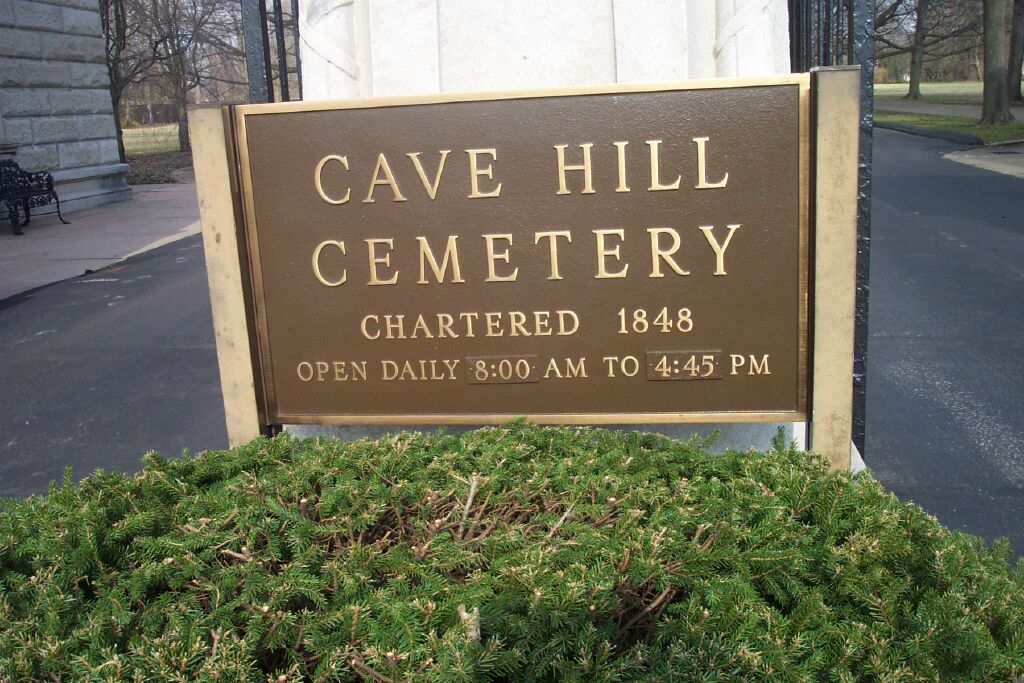
Cave Hill Cemetery
Louisville, Jefferson County, Kentucky, USA
About
-
Get directions 701 Baxter Avenue
Louisville, Kentucky 40204 United StatesCoordinates: 38.24536, -85.71464 - www.cavehillcemetery.com/
- 502-451-5630
- Cemetery ID:
Members have Contributed
Photos


Cave Hill Cemetery made the initial donation of land that established the neighboring Cave Hill National Cemetery.
Cemetery and office hours are posted on the website's Contact Us page. Visitors are encouraged to verify visiting hours before visiting. The cemetery is often closed after severe weather events.
In the 1840s, the City of Louisville acquired a portion of the Johnston family farm, known as Cave Hill. The property contained a spring emerging from a cave and several stone quarries. At the time, city officials believed the Louisville and Frankfort Railroad would pass through the area, increasing its value for industrial purposes.
When the railroad ultimately bypassed the land, the city leased the fields for farming. The brick home built by the Johnston family was repurposed as the City Pest House, used to isolate patients suffering from contagious diseases such as smallpox. Due to the nature of the Pest House, death was common on the property.
By the mid-19th century, attitudes toward burial were shifting. Traditional urban graveyards were overcrowded, unsanitary, and often contributed to the spread of disease. New approaches to burial planning favored well-designed cemeteries located outside city centers. These "rural" or "garden" cemeteries prioritized cleanliness, permanent maintenance, and scenic settings.
In late 1846, the City of Louisville decided to convert part of the Cave Hill property into a cemetery. Though officials may not have initially planned to adopt the garden cemetery model, they appointed civil engineer Edmund Francis Lee to design the grounds. Lee had knowledge of recent cemetery developments in Europe and the United States, particularly the design philosophies of John Claudius Loudon. The cemetery was chartered by the Commonwealth of Kentucky in 1848.
Lee's plan for Cave Hill made use of the land's natural contours. Elevated areas were designated for burial, while low-lying sections were developed as ponds, groves, or open reserves. Winding roads followed the terrain, allowing access to hilltop plots. The design emphasized long-term maintenance and legal protection for the grounds, setting it apart from earlier burial grounds in the city.
Cave Hill Cemetery officially opened in 1848. It now encompasses nearly 300 acres of rolling hills, 64 sinkhole basins, and remains one of the most intact examples of the rural cemetery movement in the southern United States.
The cemetery contains thousands of interments, including multi-generational family plots. For family historians and genealogical researchers, Cave Hill offers access to detailed records of burials, plot ownership, interment dates, and next of kin. These records can be used to supplement civil death records, census data, and probate files.
Cave Hill has always been a non-denominational cemetery and includes sections set aside for various groups, such as Civil War soldiers, fraternal organizations, and members of the Jewish community. It also contains a national cemetery established during the Civil War and a public lot section for individuals without private burial arrangements. Approximately 600 burials occur annually.
Monuments at Cave Hill vary widely in size, style, and materials. Many gravestones from the late 19th and early 20th centuries include occupational symbols, fraternal emblems, and family inscriptions that can provide context for genealogical research. During the Victorian period, families increasingly commissioned sculpted headstones, obelisks, and other forms of memorial art.
The grounds are also recognized as a certified arboretum, with over 500 species of trees and shrubs. Many of the plantings date back to the 19th century, maintained through continuous landscape stewardship.
Today, Cave Hill remains active and accessible to researchers. Burial information can be obtained through the website linked on this page or requested through the cemetery office. Visitors conducting on-site research should prepare by obtaining maps, as the curving roads and large grounds can be difficult to navigate. Grave locations, nearby burials, and inscriptions often provide valuable leads for identifying extended family members or clarifying family structures. The Cave Hill Foundation provides a number of guided tours of the cemetery and these can be found on the website. Additionally, the cemetery frequently offers public events which can be found on the website or social media.
Cave Hill is considered a model example of a professionally maintained, historically significant cemetery. For those researching families in Louisville or the surrounding region, it serves as both a burial site and a historical resource.
Sources: Cave Hill Cemetery: A Pictorial Guide and Its History by Samuel Thomas (1997, 2012); Cave Hill Cemetery & Arboretum; Morton Register of Arboreta (Arbnet.org); The Courier-Journal Historical Archives (Louisville, KY); A Garden in Kentucky; U.S. National Register of Historic Places Inventory Nomination Form for Cave Hill Cemetery; Filson Historical Society Manuscripts.
Cave Hill Cemetery made the initial donation of land that established the neighboring Cave Hill National Cemetery.
Cemetery and office hours are posted on the website's Contact Us page. Visitors are encouraged to verify visiting hours before visiting. The cemetery is often closed after severe weather events.
In the 1840s, the City of Louisville acquired a portion of the Johnston family farm, known as Cave Hill. The property contained a spring emerging from a cave and several stone quarries. At the time, city officials believed the Louisville and Frankfort Railroad would pass through the area, increasing its value for industrial purposes.
When the railroad ultimately bypassed the land, the city leased the fields for farming. The brick home built by the Johnston family was repurposed as the City Pest House, used to isolate patients suffering from contagious diseases such as smallpox. Due to the nature of the Pest House, death was common on the property.
By the mid-19th century, attitudes toward burial were shifting. Traditional urban graveyards were overcrowded, unsanitary, and often contributed to the spread of disease. New approaches to burial planning favored well-designed cemeteries located outside city centers. These "rural" or "garden" cemeteries prioritized cleanliness, permanent maintenance, and scenic settings.
In late 1846, the City of Louisville decided to convert part of the Cave Hill property into a cemetery. Though officials may not have initially planned to adopt the garden cemetery model, they appointed civil engineer Edmund Francis Lee to design the grounds. Lee had knowledge of recent cemetery developments in Europe and the United States, particularly the design philosophies of John Claudius Loudon. The cemetery was chartered by the Commonwealth of Kentucky in 1848.
Lee's plan for Cave Hill made use of the land's natural contours. Elevated areas were designated for burial, while low-lying sections were developed as ponds, groves, or open reserves. Winding roads followed the terrain, allowing access to hilltop plots. The design emphasized long-term maintenance and legal protection for the grounds, setting it apart from earlier burial grounds in the city.
Cave Hill Cemetery officially opened in 1848. It now encompasses nearly 300 acres of rolling hills, 64 sinkhole basins, and remains one of the most intact examples of the rural cemetery movement in the southern United States.
The cemetery contains thousands of interments, including multi-generational family plots. For family historians and genealogical researchers, Cave Hill offers access to detailed records of burials, plot ownership, interment dates, and next of kin. These records can be used to supplement civil death records, census data, and probate files.
Cave Hill has always been a non-denominational cemetery and includes sections set aside for various groups, such as Civil War soldiers, fraternal organizations, and members of the Jewish community. It also contains a national cemetery established during the Civil War and a public lot section for individuals without private burial arrangements. Approximately 600 burials occur annually.
Monuments at Cave Hill vary widely in size, style, and materials. Many gravestones from the late 19th and early 20th centuries include occupational symbols, fraternal emblems, and family inscriptions that can provide context for genealogical research. During the Victorian period, families increasingly commissioned sculpted headstones, obelisks, and other forms of memorial art.
The grounds are also recognized as a certified arboretum, with over 500 species of trees and shrubs. Many of the plantings date back to the 19th century, maintained through continuous landscape stewardship.
Today, Cave Hill remains active and accessible to researchers. Burial information can be obtained through the website linked on this page or requested through the cemetery office. Visitors conducting on-site research should prepare by obtaining maps, as the curving roads and large grounds can be difficult to navigate. Grave locations, nearby burials, and inscriptions often provide valuable leads for identifying extended family members or clarifying family structures. The Cave Hill Foundation provides a number of guided tours of the cemetery and these can be found on the website. Additionally, the cemetery frequently offers public events which can be found on the website or social media.
Cave Hill is considered a model example of a professionally maintained, historically significant cemetery. For those researching families in Louisville or the surrounding region, it serves as both a burial site and a historical resource.
Sources: Cave Hill Cemetery: A Pictorial Guide and Its History by Samuel Thomas (1997, 2012); Cave Hill Cemetery & Arboretum; Morton Register of Arboreta (Arbnet.org); The Courier-Journal Historical Archives (Louisville, KY); A Garden in Kentucky; U.S. National Register of Historic Places Inventory Nomination Form for Cave Hill Cemetery; Filson Historical Society Manuscripts.
Nearby cemeteries


- Added: 1 Jan 2000
- Find a Grave Cemetery ID: 73354

Cemetery Photos
This is a carousel with slides. Use Next and Previous buttons to navigate, or jump to a slide with the slide dots. Use Escape keyboard button or the Close button to close the carousel.


Success
Uploading...
Waiting...
Failed
This photo was not uploaded because this cemetery already has 20 photos
This photo was not uploaded because you have already uploaded 5 photos to this cemetery
This photo was not uploaded because you have already uploaded 5 photos to this cemetery
Invalid File Type
Birth and death years unknown.
1 photo picked...
2 photos picked...
Uploading 1 Photo
Uploading 2 Photos
1 Photo Uploaded
2 Photos Uploaded
This photo is larger than 20 MB. Please resize to less than 20 MB and try again.
Too many photos have been uploaded
"Unsupported file type"
• ##count## of 0 memorials with GPS displayed. Double click on map to view more.No cemeteries found