
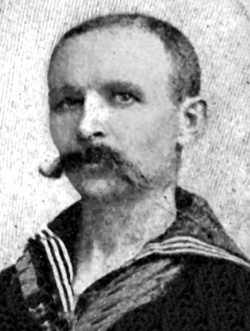
Spanish-American War Medal of Honor Recipient. He was born one of three children as George Frederick Phillips in Saint John, some sources say Coles Island, New Brunswick, Canada, to Irish Immigrants Andrew Phillips, and his wife Elizabeth Ross Phillips on March 8, 1862. He was educated locally and later worked as a mechanic for the Intercolonial Railway of Canada (or IRC), in Moncton, New Brunswick. He also worked onboard liners for the Mallory Steamship Company between New York and Texas. He then went to Galveston, Texas, where he entered military service. He was given the rank of Machinist First Class and he served in the United States Navy during the Spanish-American War in March of 1898. He was later awarded the Medal of Honor, for his role in the intentional sinking of the 3362-ton collier, the "USS Merrimac" at the entrance to the harbor of Santiago de Cuba, on June 2, 1898. During the conflict, he was aboard a ship that made its way to the entrance to the Santiago De Cuba Harbor where the "USS Merrimac" was supplying coal to U.S. warships. In a daring attempt to bottle up the Spanish cruiser squadron, the "USS Merrimac" was scuttled inside the entrance of the Santiago De Cuba Harbor in an attempt to block the passage of the Spanish fleet which was headed by Spanish Naval Admiral Pascual Cervera y Topete. While under heavy fire from the Spanish shore batteries, Machinist First Class Phillips displayed extraordinary heroism throughout this operation. He and seven of his fellow sailors were captured as Prisoners of War, yet were released a month later with an American victory. His Medal of Honor citation reads, "In connection with the sinking of the U.S.S. Merrimac at the entrance to the harbor of Santiago de Cuba on 2 June 1898. Despite heavy fire from the Spanish shore batteries, Phillips displayed extraordinary heroism throughout this operation." His Medal of Honor was awarded to him by then-President of the United States William McKinley on November 2, 1899, and it was accredited to the State of New York. He also served onboard the "U.S.S. Newark" but was discharged from the "U.S.S. Newark" on July 24, 1901, and reenlisted in the United States Navy in New York on November 21, 1901. He then served onboard the "U.S.S. Independence", a receiving ship at Mare Island, California, as a Chief Machinist until his discharge due to physical disability on August 12, 1903. He then worked as an engineer until his death. He died in Cambridge, Massachusetts, on June 4, 1904, at the age of 42, from complications Bright's disease. Following his death, his body was repatriated to his native Canada and he was buried in the Fernhill Cemetery in Saint John, New Brunswick. A newspaper of the time that reported on his death said of him, "Knew No Fear." He never married nor had any children.
Spanish-American War Medal of Honor Recipient. He was born one of three children as George Frederick Phillips in Saint John, some sources say Coles Island, New Brunswick, Canada, to Irish Immigrants Andrew Phillips, and his wife Elizabeth Ross Phillips on March 8, 1862. He was educated locally and later worked as a mechanic for the Intercolonial Railway of Canada (or IRC), in Moncton, New Brunswick. He also worked onboard liners for the Mallory Steamship Company between New York and Texas. He then went to Galveston, Texas, where he entered military service. He was given the rank of Machinist First Class and he served in the United States Navy during the Spanish-American War in March of 1898. He was later awarded the Medal of Honor, for his role in the intentional sinking of the 3362-ton collier, the "USS Merrimac" at the entrance to the harbor of Santiago de Cuba, on June 2, 1898. During the conflict, he was aboard a ship that made its way to the entrance to the Santiago De Cuba Harbor where the "USS Merrimac" was supplying coal to U.S. warships. In a daring attempt to bottle up the Spanish cruiser squadron, the "USS Merrimac" was scuttled inside the entrance of the Santiago De Cuba Harbor in an attempt to block the passage of the Spanish fleet which was headed by Spanish Naval Admiral Pascual Cervera y Topete. While under heavy fire from the Spanish shore batteries, Machinist First Class Phillips displayed extraordinary heroism throughout this operation. He and seven of his fellow sailors were captured as Prisoners of War, yet were released a month later with an American victory. His Medal of Honor citation reads, "In connection with the sinking of the U.S.S. Merrimac at the entrance to the harbor of Santiago de Cuba on 2 June 1898. Despite heavy fire from the Spanish shore batteries, Phillips displayed extraordinary heroism throughout this operation." His Medal of Honor was awarded to him by then-President of the United States William McKinley on November 2, 1899, and it was accredited to the State of New York. He also served onboard the "U.S.S. Newark" but was discharged from the "U.S.S. Newark" on July 24, 1901, and reenlisted in the United States Navy in New York on November 21, 1901. He then served onboard the "U.S.S. Independence", a receiving ship at Mare Island, California, as a Chief Machinist until his discharge due to physical disability on August 12, 1903. He then worked as an engineer until his death. He died in Cambridge, Massachusetts, on June 4, 1904, at the age of 42, from complications Bright's disease. Following his death, his body was repatriated to his native Canada and he was buried in the Fernhill Cemetery in Saint John, New Brunswick. A newspaper of the time that reported on his death said of him, "Knew No Fear." He never married nor had any children.
Bio by: The Silent Forgotten