
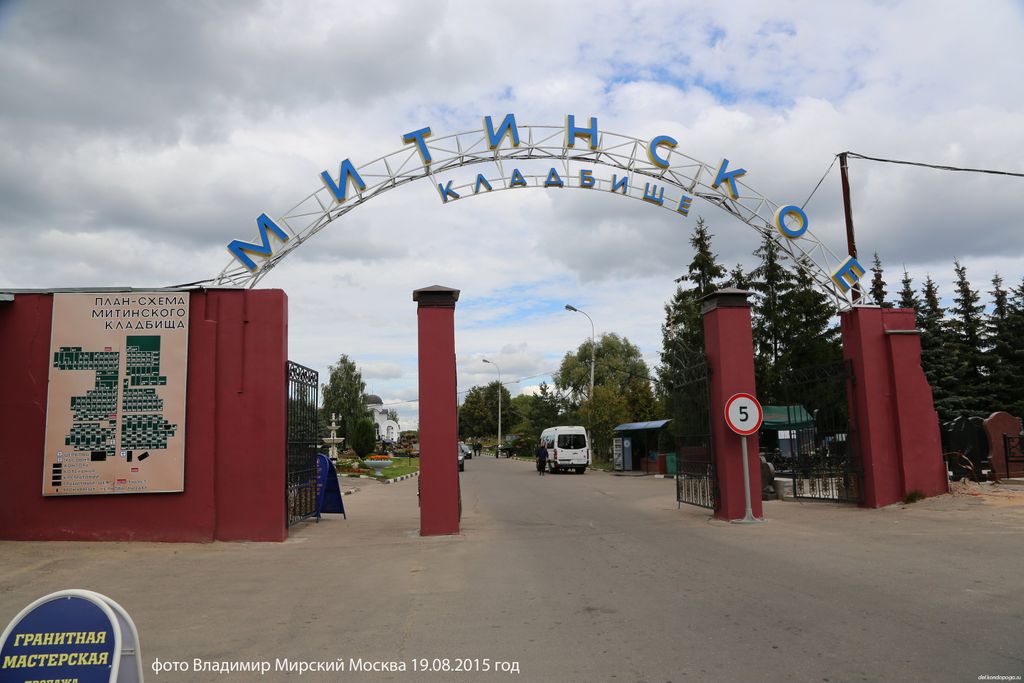
Mitinskoe Cemetery
Also known as Митинское кладбище
North-Western Administrative Okrug, Moscow Federal City, Russia
About
-
- Cemetery ID:
Members have Contributed
Photos


One of Moscow's largest cemeteries, it is located on the city's northwestern outskirts. It opened in 1978.
When the Mitino Cemetery was established, the villages of Dudino and Alekseevskoye-Pushkino disappeared—they were situated on the land set aside for the cemetery. In the fall of 1981, graves and headstones from the cemetery being closed down near the Church of All Saints by the Sokol metro station were moved to sections 58 and 59. In 1985, a crematorium was built near the cemetery.
The cemetery features the Alley of Glory (a memorial)—the burial site of the first 28 victims of the Chernobyl disaster (1986)—power plant workers and firefighters. They were buried in reinforced concrete mini-sarcophagi because they were a significant source of radiation. A monument (created by sculptor Andrei Kovalchuk and architect Viktor Korsi) has been erected in the shape of a mushroom cloud, inside which stands a man trying with his bare hands to stop the impending disaster.
Six months after the tragedy, a nationwide competition was announced to design a monument at the Mitino Cemetery, where those who were caught in the thick of the disaster—primarily nuclear power plant workers and firefighters—are buried. They had been transported from Chernobyl to hospitals in Moscow.
"I met with people who were at the nuclear power plant on April 26 and survived, and I spoke with their loved ones. It's hard to talk about those meetings, but they helped me find the right solution. My friend, architect Viktor Korsi, and I won first prize. The jury selected our proposal from over 150 entries. At first, the idea was to make a firefighter the central figure, but as we worked on it, we realized that the figure of a defenseless, naked person would be more expressive. At that time, religious themes had not yet fully returned to our aesthetic sensibilities, and the figure holding back the nuclear cloud is interpreted as an image of crucifixion—a sacrifice made for the salvation of others," says sculptor Andriy Kovalchuk.
In 1994, a chapel was erected at the cemetery in honor of the victims of Chernobyl and those who died in emergencies. Nearby, the Bell Tower of Remembrance was built with inscriptions on the bell: "Remember, O Lord, the souls of Your departed servants" and "To the heroes who died in emergencies and in the line of duty."
One of Moscow's largest cemeteries, it is located on the city's northwestern outskirts. It opened in 1978.
When the Mitino Cemetery was established, the villages of Dudino and Alekseevskoye-Pushkino disappeared—they were situated on the land set aside for the cemetery. In the fall of 1981, graves and headstones from the cemetery being closed down near the Church of All Saints by the Sokol metro station were moved to sections 58 and 59. In 1985, a crematorium was built near the cemetery.
The cemetery features the Alley of Glory (a memorial)—the burial site of the first 28 victims of the Chernobyl disaster (1986)—power plant workers and firefighters. They were buried in reinforced concrete mini-sarcophagi because they were a significant source of radiation. A monument (created by sculptor Andrei Kovalchuk and architect Viktor Korsi) has been erected in the shape of a mushroom cloud, inside which stands a man trying with his bare hands to stop the impending disaster.
Six months after the tragedy, a nationwide competition was announced to design a monument at the Mitino Cemetery, where those who were caught in the thick of the disaster—primarily nuclear power plant workers and firefighters—are buried. They had been transported from Chernobyl to hospitals in Moscow.
"I met with people who were at the nuclear power plant on April 26 and survived, and I spoke with their loved ones. It's hard to talk about those meetings, but they helped me find the right solution. My friend, architect Viktor Korsi, and I won first prize. The jury selected our proposal from over 150 entries. At first, the idea was to make a firefighter the central figure, but as we worked on it, we realized that the figure of a defenseless, naked person would be more expressive. At that time, religious themes had not yet fully returned to our aesthetic sensibilities, and the figure holding back the nuclear cloud is interpreted as an image of crucifixion—a sacrifice made for the salvation of others," says sculptor Andriy Kovalchuk.
In 1994, a chapel was erected at the cemetery in honor of the victims of Chernobyl and those who died in emergencies. Nearby, the Bell Tower of Remembrance was built with inscriptions on the bell: "Remember, O Lord, the souls of Your departed servants" and "To the heroes who died in emergencies and in the line of duty."
Nearby cemeteries


North-Western Administrative Okrug, Moscow Federal City, Russia
- 3
- 100%
- 0%

- Added: 17 Jul 2008
- Find a Grave Cemetery ID: 2268790

Cemetery Photos
This is a carousel with slides. Use Next and Previous buttons to navigate, or jump to a slide with the slide dots. Use Escape keyboard button or the Close button to close the carousel.


Success
Uploading...
Waiting...
Failed
This photo was not uploaded because this cemetery already has 20 photos
This photo was not uploaded because you have already uploaded 5 photos to this cemetery
This photo was not uploaded because you have already uploaded 5 photos to this cemetery
Invalid File Type
Birth and death years unknown.
1 photo picked...
2 photos picked...
Uploading 1 Photo
Uploading 2 Photos
1 Photo Uploaded
2 Photos Uploaded
This photo is larger than 20 MB. Please resize to less than 20 MB and try again.
Too many photos have been uploaded
"Unsupported file type"
• ##count## of 0 memorials with GPS displayed. Double click on map to view more.No cemeteries found