
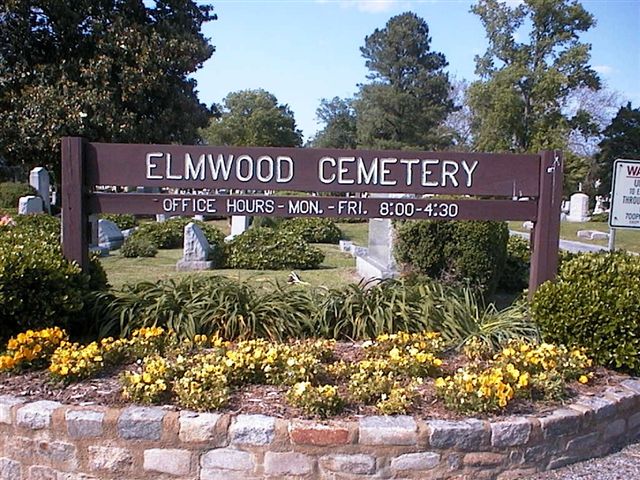
Elmwood Cemetery
Norfolk, City of Norfolk, Virginia, USA
About
-
- www.norfolk.gov/851/Bureau-of-Cemeteries
- Cemetery ID:
Members have Contributed
Photos


Norfolk's Elmwood Cemetery, listed on the National Register of Historic Places, is a fascinating insight into 19th century America. With the Parisian Victorian Rural Park Cemetery Movement in 1815, cemeteries became places that not only displayed social status, but became places to visit, reflect and contemplate, and enjoy a picnic or a stroll on a Sunday afternoon. Careful planting—particularly of trees—and architectural features that impressed or drew the eye were key features. The whole effect was that of a private, landscaped park, with a central chapel instead of a community house.
In the early 1850's, it became clear that Norfolk's public cemetery, Cedar Grove, would soon be full. John and Rebecca Tunis sold the City of Norfolk a tract of land known as Farmingdale. In 1852 a local paper published a request for proposals to build a brick wall enclosing the new cemetery. Elmwood was officially established in 1853. It was originally connected to Cedar Grove by a bridge across Smith's Creek. The 1890's saw the creek filled in with the extension of Princess Anne Avenue (now Road). That period also saw the wall extended, the addition of the entrance gate, and more land added. The cemetery comprises just under 50 acres.
Elmwood Cemetery features a tremendous variety of markers, stones, and family mausoleums. The Victorian romantic idea of death as sleep is evident in many inscriptions on stones as well as in the design of bed-like markers which include a tall head stone to resemble a headboard, a smaller foot stone or footboard and side rails—a romantic bed in which to slumber while awaiting judgment day. The majority of memorials incorporate Victorian funerary iconography—lilies, sheaves of wheat, lambs, tree trunks, roses, wreaths, seashells, anchors, cross and crowns, and shaking hands among others. Free standing angels and mourning figures are abundant including an eight-foot-tall heroic bronze recording angel crafted by internationally renowned Norfolk sculptor, William Couper. Some architectural points of interest include the Core and Le Kies mausoleums.
Tours are offered during warmer months (April–October) highlighting these features and a sampling of the notable burials.
Elmwood has no available property. Its records are housed in an office located on the grounds.
Norfolk's Elmwood Cemetery, listed on the National Register of Historic Places, is a fascinating insight into 19th century America. With the Parisian Victorian Rural Park Cemetery Movement in 1815, cemeteries became places that not only displayed social status, but became places to visit, reflect and contemplate, and enjoy a picnic or a stroll on a Sunday afternoon. Careful planting—particularly of trees—and architectural features that impressed or drew the eye were key features. The whole effect was that of a private, landscaped park, with a central chapel instead of a community house.
In the early 1850's, it became clear that Norfolk's public cemetery, Cedar Grove, would soon be full. John and Rebecca Tunis sold the City of Norfolk a tract of land known as Farmingdale. In 1852 a local paper published a request for proposals to build a brick wall enclosing the new cemetery. Elmwood was officially established in 1853. It was originally connected to Cedar Grove by a bridge across Smith's Creek. The 1890's saw the creek filled in with the extension of Princess Anne Avenue (now Road). That period also saw the wall extended, the addition of the entrance gate, and more land added. The cemetery comprises just under 50 acres.
Elmwood Cemetery features a tremendous variety of markers, stones, and family mausoleums. The Victorian romantic idea of death as sleep is evident in many inscriptions on stones as well as in the design of bed-like markers which include a tall head stone to resemble a headboard, a smaller foot stone or footboard and side rails—a romantic bed in which to slumber while awaiting judgment day. The majority of memorials incorporate Victorian funerary iconography—lilies, sheaves of wheat, lambs, tree trunks, roses, wreaths, seashells, anchors, cross and crowns, and shaking hands among others. Free standing angels and mourning figures are abundant including an eight-foot-tall heroic bronze recording angel crafted by internationally renowned Norfolk sculptor, William Couper. Some architectural points of interest include the Core and Le Kies mausoleums.
Tours are offered during warmer months (April–October) highlighting these features and a sampling of the notable burials.
Elmwood has no available property. Its records are housed in an office located on the grounds.
Nearby cemeteries


- Added: 1 Jan 2000
- Find a Grave Cemetery ID: 50142

Cemetery Photos
This is a carousel with slides. Use Next and Previous buttons to navigate, or jump to a slide with the slide dots. Use Escape keyboard button or the Close button to close the carousel.


Success
Uploading...
Waiting...
Failed
This photo was not uploaded because this cemetery already has 20 photos
This photo was not uploaded because you have already uploaded 5 photos to this cemetery
This photo was not uploaded because you have already uploaded 5 photos to this cemetery
Invalid File Type
Birth and death years unknown.
1 photo picked...
2 photos picked...
Uploading 1 Photo
Uploading 2 Photos
1 Photo Uploaded
2 Photos Uploaded
This photo is larger than 20 MB. Please resize to less than 20 MB and try again.
Too many photos have been uploaded
"Unsupported file type"
• ##count## of 0 memorials with GPS displayed. Double click on map to view more.No cemeteries found