
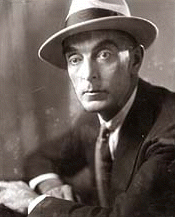
Author. He received professional recognition as an early 20th-century American novelist, sports columnist, songwriter, and playwright. Born Ringgold "Ring" Wilmer Lardner, Sr., he was the youngest of nine children of Henry Lardner and Lena Bogardus Phillips. His first name ultimately came from a friend of his uncle's, United States Navy Admiral Cadwalader Ringgold. Since he did not care for his first name, he shortened it to simply "Ring." His first job after high school was at a gas station. His employer recognized his writing ability and, in an effort to promote a literary career for him, took his writings to several newspapers before he was hired by "The South Bend Times" as a staff writer. His employer said if the newspaper job failed, he could come back to the gas station. After his writing career was a success at the newspaper, he went to Chicago for better career opportunities. In addition to sports and humor writing, he wrote songs by drumming on a piano or playing the saxophone. He composed music and wrote lyrics for plays such as "Zanzibar" in 1903. According to his obituary by the Associated Press, his most famous book was the 1916 "You Know Me, Al: A Busher's Letters," which was a writing collection in the form of letters written by the fictional character Jack Keefe to a friend back home. He published sequels to this novel over the next years as "Treat 'Em Rough: Letters From Jack the Kaiser Killer" in 1918 and "The Real Dope" in 1919. Throughout his career, he wrote for the "South Bend Times," "The Inter-Ocean," the "Chicago Examiner," the "Chicago Tribune," and other publications. His work at the "Sporting News" in St. Louis served as the basis for "You Know Me, Al." In addition to sports writing, he wrote short stories such as "Some Like Them Cold," "Haircut," and "The Golden Honeymoon." He wrote for the Ziegfeld Follies, in addition to co-authoring with George M. Cohan a Broadway three-act play, "Elmer the Great" in 1928 and "June Moon" in 1929, a comedy co-authored with George S. Kaufman. He suffered from tuberculosis and was confined to bed for the last two years of his life. He married Ellis Abbott, and the couple had four sons, who were also writers. As war correspondents, his son James was killed in the Spanish Civil War, and later David was killed during World War II. The day after his death, nationally syndicated columnist Will Rogers wrote in "Will Rogers Says" that "Ring Lardner died. You can always get better planes, better trains, but we can't get another Ring Lardner."
Author. He received professional recognition as an early 20th-century American novelist, sports columnist, songwriter, and playwright. Born Ringgold "Ring" Wilmer Lardner, Sr., he was the youngest of nine children of Henry Lardner and Lena Bogardus Phillips. His first name ultimately came from a friend of his uncle's, United States Navy Admiral Cadwalader Ringgold. Since he did not care for his first name, he shortened it to simply "Ring." His first job after high school was at a gas station. His employer recognized his writing ability and, in an effort to promote a literary career for him, took his writings to several newspapers before he was hired by "The South Bend Times" as a staff writer. His employer said if the newspaper job failed, he could come back to the gas station. After his writing career was a success at the newspaper, he went to Chicago for better career opportunities. In addition to sports and humor writing, he wrote songs by drumming on a piano or playing the saxophone. He composed music and wrote lyrics for plays such as "Zanzibar" in 1903. According to his obituary by the Associated Press, his most famous book was the 1916 "You Know Me, Al: A Busher's Letters," which was a writing collection in the form of letters written by the fictional character Jack Keefe to a friend back home. He published sequels to this novel over the next years as "Treat 'Em Rough: Letters From Jack the Kaiser Killer" in 1918 and "The Real Dope" in 1919. Throughout his career, he wrote for the "South Bend Times," "The Inter-Ocean," the "Chicago Examiner," the "Chicago Tribune," and other publications. His work at the "Sporting News" in St. Louis served as the basis for "You Know Me, Al." In addition to sports writing, he wrote short stories such as "Some Like Them Cold," "Haircut," and "The Golden Honeymoon." He wrote for the Ziegfeld Follies, in addition to co-authoring with George M. Cohan a Broadway three-act play, "Elmer the Great" in 1928 and "June Moon" in 1929, a comedy co-authored with George S. Kaufman. He suffered from tuberculosis and was confined to bed for the last two years of his life. He married Ellis Abbott, and the couple had four sons, who were also writers. As war correspondents, his son James was killed in the Spanish Civil War, and later David was killed during World War II. The day after his death, nationally syndicated columnist Will Rogers wrote in "Will Rogers Says" that "Ring Lardner died. You can always get better planes, better trains, but we can't get another Ring Lardner."
Bio by: Donna Di Giacomo