
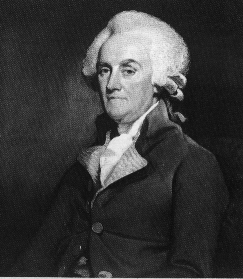
Colonial Governor of New Jersey. He was the last colonial governor of New Jersey. The illegitimate son of Benjamin Franklin, he remained loyal to England during the American Revolution, leading to a virtually complete break with his famed father. Raised in Philadelphia, the identity of his mother remains a matter of conjecture; his mother was probably either a prostitute, or Franklin's future wife, Deborah Reed. He was well educated under his father's direction, became a captain of militia during King George's War, and assisted Dr. Franklin in the pursuit of land grants, and in the famous kite experiment. While in England finishing his education, he was admitted to the bar and married Elizabeth Downes. His only son, William Temple Franklin, was to be raised by, and later become an aide to, his grandfather. He returned in 1763 with an appointment as Royal Governor of New Jersey. While in office, he signed the charter for Queen's College, which became Rutgers University, and remained loyal to the Crown despite the growing spirit of independence. Arrested in 1776, he was held prisoner in Connecticut for two years, then became active in the Loyalist community of New York City. He fled to England in 1782, never to return to the United States. An attempt to patch up relations with his father via letter in 1784 came to naught. The two met for a final time in London in 1785, which was devoted mainly to business arrangements; thereafter, correspondence was polite, but scant. He was left little in Dr. Franklin's will, lived out his days in London, and died essentially broke.
Colonial Governor of New Jersey. He was the last colonial governor of New Jersey. The illegitimate son of Benjamin Franklin, he remained loyal to England during the American Revolution, leading to a virtually complete break with his famed father. Raised in Philadelphia, the identity of his mother remains a matter of conjecture; his mother was probably either a prostitute, or Franklin's future wife, Deborah Reed. He was well educated under his father's direction, became a captain of militia during King George's War, and assisted Dr. Franklin in the pursuit of land grants, and in the famous kite experiment. While in England finishing his education, he was admitted to the bar and married Elizabeth Downes. His only son, William Temple Franklin, was to be raised by, and later become an aide to, his grandfather. He returned in 1763 with an appointment as Royal Governor of New Jersey. While in office, he signed the charter for Queen's College, which became Rutgers University, and remained loyal to the Crown despite the growing spirit of independence. Arrested in 1776, he was held prisoner in Connecticut for two years, then became active in the Loyalist community of New York City. He fled to England in 1782, never to return to the United States. An attempt to patch up relations with his father via letter in 1784 came to naught. The two met for a final time in London in 1785, which was devoted mainly to business arrangements; thereafter, correspondence was polite, but scant. He was left little in Dr. Franklin's will, lived out his days in London, and died essentially broke.
Bio by: Bob Hufford
Gravesite Details
Buried on November 25, 1813