John Donne
- Member for
- 16 years 4 months 12 days
- Find a Grave ID
Bio
Actually I am a Christian and indeed a Roman Catholic, so that I do not expect 'history' to be anything but a 'long defeat'—though it contains…some samples or glimpses of final victory.
J.R.R. Tolkien
John Donne (1572-1631) was an English poet, scholar, soldier and secretary born into a recusant Roman Catholic family at a time when practice of the faith was illegal during the Reformation. He later became a cleric in the Church of England and is probably best known for this sonnet, a linguistic memento mori:
"No man is an island entire of itself;
every man is a piece of the continent,
a part of the main;
if a clod be washed away by the sea,
Europe is the less, as well as if
a promontory were, as well as any manner
of thy friends or of thine own were;
any man's death diminishes me,
because I am involved in mankind.
And therefore never send to know for whom
the bell tolls; it tolls for thee."
Count that day Lost,
Whose low descending sun,
Views at thy hand,
No worthy action done.
George Eliot
Then Jesus said to them, "Give back to Caesar what is Caesar's and to God what is God's." And they were amazed at him.
Mark 12:17 (NIV)
For the things we see now will soon be gone, but the things we cannot see will last forever.
2 Corinthians 4:18 (St. Paul)
To be ignorant of what occurred before you were born is to remain always a child. For what is the worth of human life, unless it is woven into the lives of our ancestors by the records of history?
Marcus Tullus Cicero
Poor is the nation that has no heroes, but poorer still is the nation that having heroes, fails to remember and honor them.-
Id
Their bodies are buried in peace; but their name liveth for evermore.
Ecclesiasticus 44:14
Strive to live in peace, before hoping to rest in peace.
Me, myself and I
Zeus guided mortals to have wisdom
and laid it down with authority
that from suffering comes learning.
And, in our sleep, at least, pain of unforgettable suffering
falls drop by drop upon the heart,
and wisdom comes to us against our will:
Perhaps the favor of the gods sitting on their
sacred throne comes about through force.
Aeschylus, "Agamemnon", 176-183
Not for fame or reward, not for place or for rank, not lured by ambition or goaded by necessity, but in simple obedience to duty as they understood it. They suffered all, sacrificed all, dared all, and died.
Anon.
The past is never dead. It's not even past.
William Faulkner
Wise men speak because they have something to say, fools speak because they have to say something.
Plato
If liberty means anything at all, it means the right to tell people what they do not want to hear.
George Orwell
Dog is God spelled backwards.
Cat is TAC spelled backwards (Totally amazing creature)
Dear Ancestor:
Your tombstone stands among the rest, neglected and alone -
The name and date are chiseled out on polished marbled stone.
It reaches out to all who care, It is too late to mourn,
You did not know that I exist, You died and I was born.
Yet each of us are cells of you in flesh, in blood, in bone -
Our blood contracts and beats a pulse, entirely not our own.
Dear Ancestor, the place you filled one hundred years ago,
Spreads out among the ones you left who would have loved you so.
I wonder if you lived and loved, I wonder if you knew -
That some day I would find this spot and come to visit you.
Walter Butler Palmer (1868-1932) written in 1906.
The Battle of Manila Bay and USS Olympia (1898): A turning point in American History.
The pivotal naval battle on May 1, 1898 was the first significant conflict of the Spanish American War fought during April to August, 1898. It has been called "the Forgotten War" and "a splendid, little war". The first is mostly a true statement, and the second is mostly untrue, since few today would consider any war "splendid". But Manila Bay marked a significant progression in American History. On April 30, 1898, America's navy, and so America, was not regarded among the elite global superpowers. As the sun set on May 1, 1898, the sun rose on America's day as a global superpower. May it never set. Peace through strength.
There were 33 officers, 378 sailors and 44 marines on the United States Flagship (USFS) Olympia, leading Commodore George Dewey's small, seven-ship Asiatic Squadron, when it destroyed the larger, but antiquated and outgunned Pacific Fleet of Spanish Rear Admiral Patricio Montojo y Pasarón. Before Dewey calmly said to Olympia's captain, "You may fire when you are ready, Gridley", America and its Navy were not considered a global power. Overnight, with the complete vanquishing of Spain's Pacific Squadron in four hours, America earned that status. This USS Olympia 1898 Manila Bay Crew Virtual Cemetery is dedicated to the men of USFS Olympia. Grateful thanks to Andrew, whose relentless sleuthing over the past few years has led to discovery of the final resting place of more than a few of the sailors and marines that presented heightened challenges to locating them.
"The Men Behind the Guns"
The turret captain of Olympia's forward, twin 8-inch, main battery (No. 1 turret) that historic day was Lieutenant Stokeley Morgan, a 38-year-old Arkansas native and son of a former Confederate Civil War regimental commander. During the entire battle that lasted for a few hours, Lt. Morgan bravely stood exposed to enemy fire atop the scorching, Harveyized steel turret under a relentless, tropical sun and directed the firing of the 8" guns. Shortly after the fall of Manila that August, Morgan fell ill, having suffered severe neurological damage from the shell concussions as he stood on the turret. He was 41 when he died of paralysis in the fall of 1900 at his home in Massachusetts. Lieutenant Commander Morgan is buried at the U.S. Naval Academy cemetery where his gravestone displays bronze relief facsimiles of the famous Dewey Medal that was awarded in 1899 by special Act of Congress to the 1,825 officers and men of Commodore Dewey's squadron at the Battle of Manila Bay.
Inside the stifling No. 1 turret, where rivulets of sweat coursed down the shaved-head gun crews and the thundering shocks caused some men to bleed from their eyes, the gun captain who aimed and fired the first shot from Olympia's forward 8" starboard gun on Morgan's order from Captain Charles V. Gridley, was the ship's respected 38-year-old Chief Boatswain's Mate, Patrick Murray. Murray also fired what is regarded as the best shot of the entire engagement that raked the Spanish flagship, Reina Christina, from stem to stern as she charged head-on towards Olympia, shattering the Spanish cruiser's steering mechanism and causing dozens of casualties among the enemy's crew, including her captain.
Several months earlier, while the cruiser was ported at Nagasaki, Japan, over Christmas 1897, the crew organized a charity party for the local children. The ship's newspaper, "The Bounding Billow", reported that the 8" aft gun turret "groaned" under the weight of a massive Christmas tree that was festooned with every kind of decoration imaginable- paper dolls, watches, clothes, fans, and red radishes that were "provided by a number of good Samaritans led by Chief Bo' sun's Mate Murray who has the heartfelt thanks and Best Wishes for a Happy New Year of all the little Boys and Girls."
An Irish Catholic immigrant from Baltimore, MD, Pat Murray was attached to Olympia in March 1895, a month after the cruiser was commissioned at Mare Island, CA. Murray served on more than 30 ships during his 31-years in the Navy and earned seven Good Conduct awards, before he retired in April 1907 from his last station on the venerable, Civil War veteran, USS Hartford, then a training ship for Naval Academy midshipman. Olympia sailor, John Brockaway, aka "Lieu" Tisdale, in his memoirs, Three Years Behind the Guns: The True Chronicles of a "Diddy-Box" (1908), recalled, Pat Murray "as quiet and well behaved a gentleman as one would ask to meet in civil walks." Tisdale's book recounts an amusing incident where Murray was directing a crew that was lowering a boat, when an inter-meddling lieutenant piped up, "Lower a little aft there." Murray paid no attention, but blew his bo'sun's call (whistle) and ordered his crew, "Lower a little forward, there," which the men obeyed. The apoplectic officer took off his sword belt and shoved it towards Murray saying, "Here, you'd better take my sword." Unfazed, Murray responded, "Very well," as he took off his cap to remove the lanyard around his neck, "You take my whistle." Buckling his sword belt back on, the officer indignantly retreated to the aft of the ship while letting loose a volley of curses that "would have enriched the vocabularies of Seaman McCue or Jack Weir." (two of Olympia's "oldest salts")
After his death in 1915 from tuberculosis at age 55, CBM Pat Murray was buried at New Cathedral Cemetery in Baltimore with military honors by sailors from that city's recruiting station. His gravestone bears an incised, fouled anchor superimposed with "USN" forming a Mariner's Cross. The Irish Standard noted in his obituary that he had fired the first shot in the Battle of Manila Bay and "was most popular amongst the officers and men of the fleet."
Firing shoulder to shoulder with Murray, the port gun captain in No. 1 turret was Gunner's Mate 1c John Christopher Jordan, the 26-year-old African-American son of a Virginia freeman, and native of Washington, D.C. , where his father was a laborer at the US Capital. Jordan was detached from the cruiser, USS Baltimore and to Olympia on April 24, 1898, a week before the Battle of Manila Bay. This was likely by Commodore Dewey's design to have Jordan's gunnery and diving skills on the flagship for the coming battle. In 1892, Jordan had been the first black man to graduate from the Navy's Seaman Gunner school. He was a popular athlete and part of Olympia's musical troupe during his eight months on the cruiser. During his 29-years in the Navy, Jordan rose to Chief Gunner's Mate and earned six Good Conduct Awards, an exceptional accomplishment for any sailor, and monumental for a black man in the Navy of more than a century ago. CGM John Jordan was 52 when he died of tubercular meningitis in 1923 at the U.S. Naval Hospital in Philadelphia. His older brother, Thomas, an army veteran, brought his remains back to the family plot at Harmony Memorial Park, a historic African-American cemetery outside of Washington, D.C. The grave of Chief Gunner's Mate John Jordan is shamefully unmarked, and probably has been for more than 65 years since the cemetery was moved in the 1950s and most grave markers were lost. Should a proper memorial be erected to honor his final resting place, kindly inform the writer.
According to a September 1899 interview of Olympia's warrant officer Gunner, Leonard J. Kuhlwein, "Murray and Jordan were the best shots on the ship, and so the handling of the big guns was given to them." After the destruction of the Spanish Pacific squadron by Dewey's seven ships, and perhaps as an expression of the Commodore's satisfaction with his gunners' performance, Olympia engaged in impromptu competitive gunnery practice targeting a couple of burning Spanish transport hulks that had been beached. It's unclear who won the 19th hole honors but the Commodore enjoyed the show.
Six score years ago, the US Navy conferred Stokeley Morgan, Pat Murray and J. C. Jordan their military ranks and responsibilities based on the knowledge, skills and qualifications that each had demonstrated, and not on a secular, pseudo-virtuous and poisonous fixation with immutable and superficial characteristics that only serves to divide Americans into tribes and foster discrimination. To paraphrase the words spoken by Rev. Dr. Martin L. King, Jr. 65 years after the Battle of Manila Bay, these three brothers-at-arms were judged not by the color of their skin but the content of their character.
For the USS Olympia, Battle of Manila Bay Crew virtual cemetery, newspaper articles, obituaries, headstone photos (if memorial has none), photos of USS Olympia sailors, marines and their families or their prized Congressional Dewey Medals are welcome, as are suggested edits and further biographical information. Feel free to send me a message, I'd like to hear from you. God bless America, and all who read this.
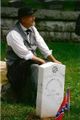
Burial records and information engraved on headstones are not infallible. For example, here's a headstone at Arlington Nat'l. Cemetery (ANC) in Virginia, that for more than 70 years marked the grave of a Manila Bay USS Olympia sailor and later World War I Army second lieutenant, but erroneously was inscribed to a Spanish American War Army captain buried at Jefferson Barrack's Nat'l. Cemetery at St. Louis. I discovered this mistaken identity in 2020 and notified ANC. After nearly a year and verifying the evidence I provided them, the ANC administrators placed a correct headstone in April 2021.
USS Olympia (C-6)
The newly formed Navy Board on the Design of Ships began the design process for Cruiser Number 6 in 1889. For main armament, the board chose 8-inch (200 mm) guns, though the number and arrangement of these weapons, as well as the armor scheme, was heavily debated. On 8 April 1890, the navy solicited bids but found only one bidder, the Union Iron Works at San Francisco, CA. The contract specified a cost of $1,796,000, completion by 1 April 1893, and offered a bonus for early completion. During the contract negotiations, Union Iron Works was granted permission to lengthen the vessel by 10 ft. (3.0 m), at no extra cost, to accommodate the propulsion system. The contract was signed on 10 July 1890. The naval architect who designed and drew the lines for Olympia was William Bell Collier, II of San Francisco. Bell was also a ranked, amateur tennis player at the turn of the last century.
For further reading on USS Olympia, the world's oldest surviving steel-hulled warship that can be toured at Philadelphia's Independence Seaport, and the iconic Battle of Manila Bay Medal, commonly known as the "Dewey Medal", that was authorized by Act of Congress in 1898 to be struck by Tiffany & Co, and individually named and awarded to each of the 1,848 sailors and marines of Dewey's Asiatic Squadron at Manila Bay, I suggest the following:
Stewart, Robert, "Historic American Engineering Record: USS Olympia", (1998) Independence Seaport Museum, Phila., PA
digital copy here: http://lcweb2.loc.gov/master/pnp/habshaer/pa/pa3500/pa3529/data/pa3529data.pdf
Tisdale, John B., aka Lieu (USS Olympia crewman) Three Years Behind the Guns: The True Chronicles of a "Diddy-Box" (1908). (available on amazon.com)
***
A Few Family memorials-
My mother's older sister, Barbara Clara Gehrig Johnson, recently passed away in April, 2026 at age 105 and seven months, at her home outside of Seattle, WA. Named for her maternal grandmother, who died in a housefire that her two-year old mother accidentally started when she knocked over a lamp, her middle name honors aunts on both sides of the family. Barb was a tireless, ebullient force for good, and blessed with a keen mind and zest for living all her days until the Lord finally called her to His eternal home. Earning her nursing degree before Pearl Harbor, Barb initially worked at a foundry in her native Minnesota treating industrial accidents. Back when flight attendants also had to be registered nurses, she joined Northwest Orient Airlines in the 1940's, a decade before commercial jet travel. Barb was a flight attendant on Northwest's first transcontinental, regular service "red eye" night flight from Seattle to New York in 1949. She married the next year and she and her husband, Owen, an attorney, had a 51-year happy marriage until his passing, and raised five beautiful daughters, at their spacious, two-story, balconied, canary-yellow home on Sheridan Beach at Lake Washington. A talented musician who could "play by ear", she taught herself many instruments, but was particularly fond of the ukele, and joined a group, also, singing whenever she could. Would you believe she also took up hula dancing at 88, joined a group of seniors hula dancers and last shook her skirt at 105?
My uncle, RADM (Dr.) Leo Joseph Gehrig, USPHS, was a thoracic surgeon and career US Public Health Service Uniformed Service Officer. His first duty was in the Territory of Alaska in 1945 where he worked across the region to eradicate small pox. He was the first Medical Director of the Peace Corps, 1961-1962 and later appointed Deputy Surgeon General of the United States, 1966-1970, by President Lyndon B. Johnson. My uncle was an amazing man of many talents, solidly part of the "Greatest Generation" and it was a privilege to know him as a kid living in Washington, D.C. from 1964-74.
Barbara (Kiffe) Hund, my great-grandmother, died at 33 on 4th of July 1900 from burns received the night before in a house-fire that was started when my two-year-old grandmother, Marcella Hund Gehrig, accidentally knocked over a kerosene lamp. My great-grandmother and her seven children had all made it out safely from their two-story house at Mankato, MN. But in the nighttime commotion, she panicked when she didn't see Marcella and ran back into the house. Barbara didn't know that her oldest boy, 11-year-old Leo Hund had put his baby sister in a basket and slid her down the stairs to safety.
After helping his widowed father to raise his younger siblings and run the family butcher shop, Leo joined the Navy at 24, after moving from his small Minnesota town to NYC a couple years earlier. Leo Hund was honorably discharged as a quartermaster second class (QM2c) in July 1916 to return to civilian life. The month after the US declared war on Germany, he reenlisted at Newport, RI and was appointed a chief quartermaster (QMC). Appointed an ensign in the US Naval Reserve Force (USNRF) in January 1918, he requested sea duty and was assigned to the new battleship, USS Arizona (BB-39), where he commanded a 5-inch gun crew. However, Arizona was deemed too valuable to risk loss to a German U-boat and so it stayed close to the Atlantic coast. Leo was not content to remain out of harm's way, and his request for duty in the "War Zone" led to assignment on a mine-layer, USS Saranac, in the North Sea off Scotland.
True to his middle name "George", after the saint who slayed a fire-breathing dragon, Leo showed his character again when the old, mostly wooden Saranac caught fire in the middle of the night as it lay at anchor off Norfolk, VA in January 1919. Losing all his personal effects, Leo was one of the officers credited with saving the ship by then Assistant Secretary of the Navy, Franklin D. Roosevelt. Twenty-years later, after seeing his old ship Arizona sunk at its berth and more than a thousand of its crew killed during the attack on Pearl Harbor, Leo, then a postal worker in New York City, became a civil defense warden in his Long Island neighborhood and converted his garage to a first aid station.
My great-great-aunt, Anna "Annie" Kiffe was a 54-year-old murder-victim, stabbed to death at San Diego, CA in 1933. Annie, who worked as a retail supervisor for many years, was then employed as a temporary housekeeper for a wealthy, single, female psychiatrist, whose regular housekeeper was on vacation. Under false pretext, the psychiatrist had brought the killer, another prominent female psychiatrist described as her "intimate friend", to the former's posh home from the mental hospital where she had been involuntarily admitted. Anna's employer obtained the killer's inpatient discharge after she misrepresented to hospital officials that she was taking the woman for "treatment and recuperation at another hospital".
Nationwide, newspapers covered the sensational crime and trial, wherein the murderer, who had also stabbed her friend severely, was acquitted by reason of insanity. To add insult to injury, the killer, from an influential Rochester, NY family, was the first beneficiary of a new California law that provided for her release to her home state, where she was soon released to her family. Anna's employer also evaded any criminal or professional accountability for her deceit in lying that she was taking her disturbed friend to another hospital, instead bringing her home where she murdered Anna in cold blood. Anna, who was single and a devout Catholic, had bequeathed her estate, approximately $60k today, to several San Diego Catholic charities.
My grandfather, Paul Peter Gehrig , was one of nine siblings born in the south-central Minnesota farming town of Cologne. Growing up speaking German at home and English in public, he worked on his father's farm for a few years before joining the Chicago, Milwaukee, St. Paul and Pacific Railroad ("Milwaukee Road") in 1913, the year his father died. For the first ten years or so, he was the telegrapher at the Watson, MN depot. Paul worked for the railroad for 45 years. During the latter 1920s and through the early 1940's the family lived in Minneapolis, and in 1942 moved to Duluth when Paul was named head freight agent at Duluth, on the western tip of Lake Superior.
In June 1938, Paul, Marcella and their five kids, aged 20 through seven, boarded the Milwaukee Road's sleek silver-bullet "Olympian" bound from Minneapolis to Los Angeles for a family vacation to the West Coast to visit relatives. At 1235 am on June 18, as the train sped through the darkness in Prairie County, Montana, it crossed the bridge at Custer Creek near Saugus, unaware that some of the wooden supports had been washed away in a flash flood earlier that night. The bridge collapsed, hurtling the engine into the muddy creek-bank and dumping the seven passenger cars into the swollen rapids. At least 47 people died, including the engineer and fireman, and 75 were injured.
Paul and his three boys, Leo, 20, Paul, 16, and Jack, 14, helped other passengers to escape the partially submerged Pullman cars in the darkness of the rapidly flowing creek, and their selfless acts were recounted in the newspapers. None of the seven Gehrigs, including Marcella and her two daughters, Barbara, 18 and Maureen, 7, were injured beyond bruises. The Custer Creek train wreck (sometimes called the Saugus train wreck), was the worst rail disaster in Montana history and the worst US rail disaster of the 1930s.
During World War II, "Grampa Gehrig" received awards for moving record amounts of iron ore from the Mesabi Iron Range by rail to the steel production cities in the Midwest and East. Already a skilled telegrapher, he had volunteered for the Navy during World War I and was sent to study at the Naval Radio School that months earlier had been established on the campus of Harvard University at Cambridge, MA. His final rate was radioman second class (RM2C).
My grandfather, who went to school only through the eighth-grade, listened more than he spoke, and had a quick, dry sense of humor. Straight-faced, he delighted in telling people that he was a "Harvard man". An avid hunter and fisherman all his life, he was also a formidable bridge and chess player, whom I had the pleasure of beating a few times as an adolescent. A wise and patient man who never lost his temper, he and my grandma were devout Catholics all their lives. I regard him as one of the saints that walk among us that I've been blessed to know, largely from summer vacation trips spent alone with him for hours on his aluminum fishing boat at "Mud Lake" waiting for a bite in the "Land of 10,000 lakes and 1,000 fish" as I used to needle him.
My other grandparents, Thomas "Tommy" Cook, Jr. and Elmira Leona (Jenson) Cook were both raised on farms in northeast North Dakota near the Canadian border. They were hard-working and honest people of faith, who didn't have a lot, but would give the shirt off their backs to help someone less fortunate, as they sometimes did during the Great Depression. My grandfather farmed with his brothers on their father's land and also worked as a WPA surveyor during the Depression. My grandmother was a formidable cook and baker, who later worked at a bakery after they moved to Duluth in 1942, where my grandfather was employed for years at Diamond Tool and Horseshoe. For many years, my grandmother was the beloved cook at Morgan Park School, across the street from their modest house, in Morgan Park, the nation's first planned community built by J.P. Morgan for his Duluth steel plant workers in 1914. I was fortunate to know my grandparents well and still have one of the prized afghans that my grandfather knitted and sold at hobby shows in his later years. From my appropriately named "Gramma Cook", I got my enjoyment of cooking and a few, genuine "grandma's recipes."
Francis Cook, Jr. was my first cousin, once removed. As a youth in rural Pembina County, North Dakota in the late 1930's, he was a track and field star who set state records during high school that stood for decades. He enlisted in the Navy at Minneapolis in June 1940 right after graduation. His first ship was the aircraft carrier, USS Lexington (CV-2) where he reported after completing basic training. By the time World War II started, he was an Aviation Radioman 3cl (ARM3c) flying in the Douglas TBD Devastator (torpedo bomber) off Lexington. He was aboard the carrier when it was sunk at the Battle of the Coral Sea in 1942. Francis was among the last sailors to abandon the Lexington and recalled years later that the bitter end of the Lexington was sweetened after a ship's stores officer started handing out free ice-cream in the big 5 gallon containers. During the calm and orderly abandoning of the stricken ship, Francis and about a dozen other sailors chatted with the journalist, Stanley Johnston, who later wrote "Queen of the Flattops", just before they dropped into the Coral Sea, to be picked up the heavy cruiser, USS Minneapolis.
Francis served 20 years active duty in the Navy and retired as a warrant officer Chief Aviation Radioman (ACRM) in 1960, to work for the airlines in Miami, although he remained in the reserves until 1967 and earned six awards of the Navy Good Conduct Medal. Tragically and cruelly for such an athletic and active man, Francis developed Parkinson's Disease in his late 40s. I had the pleasure to know him when I was going to high-school in Miami, FL and he and his wife lived on Key Biscayne. He was as friendly and easy-going as they come.
*******
Concerning the dogma prevalent on this site regarding military ranks or rates on memorials-
Some users on this site obdurately insist that military titles must not be used unless the serviceman died on active duty. Putting that nonsense aside, for the veterans' memorials I am humbled to manage, I make this determination on a case by case basis. I'm generally agreeable to suggested edits that rank/rate be shown where previously not displayed. However, if a memorial I manage displays the veteran's rank/rate, it would require a compelling reason for me to remove it.
Actually I am a Christian and indeed a Roman Catholic, so that I do not expect 'history' to be anything but a 'long defeat'—though it contains…some samples or glimpses of final victory.
J.R.R. Tolkien
John Donne (1572-1631) was an English poet, scholar, soldier and secretary born into a recusant Roman Catholic family at a time when practice of the faith was illegal during the Reformation. He later became a cleric in the Church of England and is probably best known for this sonnet, a linguistic memento mori:
"No man is an island entire of itself;
every man is a piece of the continent,
a part of the main;
if a clod be washed away by the sea,
Europe is the less, as well as if
a promontory were, as well as any manner
of thy friends or of thine own were;
any man's death diminishes me,
because I am involved in mankind.
And therefore never send to know for whom
the bell tolls; it tolls for thee."
Count that day Lost,
Whose low descending sun,
Views at thy hand,
No worthy action done.
George Eliot
Then Jesus said to them, "Give back to Caesar what is Caesar's and to God what is God's." And they were amazed at him.
Mark 12:17 (NIV)
For the things we see now will soon be gone, but the things we cannot see will last forever.
2 Corinthians 4:18 (St. Paul)
To be ignorant of what occurred before you were born is to remain always a child. For what is the worth of human life, unless it is woven into the lives of our ancestors by the records of history?
Marcus Tullus Cicero
Poor is the nation that has no heroes, but poorer still is the nation that having heroes, fails to remember and honor them.-
Id
Their bodies are buried in peace; but their name liveth for evermore.
Ecclesiasticus 44:14
Strive to live in peace, before hoping to rest in peace.
Me, myself and I
Zeus guided mortals to have wisdom
and laid it down with authority
that from suffering comes learning.
And, in our sleep, at least, pain of unforgettable suffering
falls drop by drop upon the heart,
and wisdom comes to us against our will:
Perhaps the favor of the gods sitting on their
sacred throne comes about through force.
Aeschylus, "Agamemnon", 176-183
Not for fame or reward, not for place or for rank, not lured by ambition or goaded by necessity, but in simple obedience to duty as they understood it. They suffered all, sacrificed all, dared all, and died.
Anon.
The past is never dead. It's not even past.
William Faulkner
Wise men speak because they have something to say, fools speak because they have to say something.
Plato
If liberty means anything at all, it means the right to tell people what they do not want to hear.
George Orwell
Dog is God spelled backwards.
Cat is TAC spelled backwards (Totally amazing creature)
Dear Ancestor:
Your tombstone stands among the rest, neglected and alone -
The name and date are chiseled out on polished marbled stone.
It reaches out to all who care, It is too late to mourn,
You did not know that I exist, You died and I was born.
Yet each of us are cells of you in flesh, in blood, in bone -
Our blood contracts and beats a pulse, entirely not our own.
Dear Ancestor, the place you filled one hundred years ago,
Spreads out among the ones you left who would have loved you so.
I wonder if you lived and loved, I wonder if you knew -
That some day I would find this spot and come to visit you.
Walter Butler Palmer (1868-1932) written in 1906.
The Battle of Manila Bay and USS Olympia (1898): A turning point in American History.
The pivotal naval battle on May 1, 1898 was the first significant conflict of the Spanish American War fought during April to August, 1898. It has been called "the Forgotten War" and "a splendid, little war". The first is mostly a true statement, and the second is mostly untrue, since few today would consider any war "splendid". But Manila Bay marked a significant progression in American History. On April 30, 1898, America's navy, and so America, was not regarded among the elite global superpowers. As the sun set on May 1, 1898, the sun rose on America's day as a global superpower. May it never set. Peace through strength.
There were 33 officers, 378 sailors and 44 marines on the United States Flagship (USFS) Olympia, leading Commodore George Dewey's small, seven-ship Asiatic Squadron, when it destroyed the larger, but antiquated and outgunned Pacific Fleet of Spanish Rear Admiral Patricio Montojo y Pasarón. Before Dewey calmly said to Olympia's captain, "You may fire when you are ready, Gridley", America and its Navy were not considered a global power. Overnight, with the complete vanquishing of Spain's Pacific Squadron in four hours, America earned that status. This USS Olympia 1898 Manila Bay Crew Virtual Cemetery is dedicated to the men of USFS Olympia. Grateful thanks to Andrew, whose relentless sleuthing over the past few years has led to discovery of the final resting place of more than a few of the sailors and marines that presented heightened challenges to locating them.
"The Men Behind the Guns"
The turret captain of Olympia's forward, twin 8-inch, main battery (No. 1 turret) that historic day was Lieutenant Stokeley Morgan, a 38-year-old Arkansas native and son of a former Confederate Civil War regimental commander. During the entire battle that lasted for a few hours, Lt. Morgan bravely stood exposed to enemy fire atop the scorching, Harveyized steel turret under a relentless, tropical sun and directed the firing of the 8" guns. Shortly after the fall of Manila that August, Morgan fell ill, having suffered severe neurological damage from the shell concussions as he stood on the turret. He was 41 when he died of paralysis in the fall of 1900 at his home in Massachusetts. Lieutenant Commander Morgan is buried at the U.S. Naval Academy cemetery where his gravestone displays bronze relief facsimiles of the famous Dewey Medal that was awarded in 1899 by special Act of Congress to the 1,825 officers and men of Commodore Dewey's squadron at the Battle of Manila Bay.
Inside the stifling No. 1 turret, where rivulets of sweat coursed down the shaved-head gun crews and the thundering shocks caused some men to bleed from their eyes, the gun captain who aimed and fired the first shot from Olympia's forward 8" starboard gun on Morgan's order from Captain Charles V. Gridley, was the ship's respected 38-year-old Chief Boatswain's Mate, Patrick Murray. Murray also fired what is regarded as the best shot of the entire engagement that raked the Spanish flagship, Reina Christina, from stem to stern as she charged head-on towards Olympia, shattering the Spanish cruiser's steering mechanism and causing dozens of casualties among the enemy's crew, including her captain.
Several months earlier, while the cruiser was ported at Nagasaki, Japan, over Christmas 1897, the crew organized a charity party for the local children. The ship's newspaper, "The Bounding Billow", reported that the 8" aft gun turret "groaned" under the weight of a massive Christmas tree that was festooned with every kind of decoration imaginable- paper dolls, watches, clothes, fans, and red radishes that were "provided by a number of good Samaritans led by Chief Bo' sun's Mate Murray who has the heartfelt thanks and Best Wishes for a Happy New Year of all the little Boys and Girls."
An Irish Catholic immigrant from Baltimore, MD, Pat Murray was attached to Olympia in March 1895, a month after the cruiser was commissioned at Mare Island, CA. Murray served on more than 30 ships during his 31-years in the Navy and earned seven Good Conduct awards, before he retired in April 1907 from his last station on the venerable, Civil War veteran, USS Hartford, then a training ship for Naval Academy midshipman. Olympia sailor, John Brockaway, aka "Lieu" Tisdale, in his memoirs, Three Years Behind the Guns: The True Chronicles of a "Diddy-Box" (1908), recalled, Pat Murray "as quiet and well behaved a gentleman as one would ask to meet in civil walks." Tisdale's book recounts an amusing incident where Murray was directing a crew that was lowering a boat, when an inter-meddling lieutenant piped up, "Lower a little aft there." Murray paid no attention, but blew his bo'sun's call (whistle) and ordered his crew, "Lower a little forward, there," which the men obeyed. The apoplectic officer took off his sword belt and shoved it towards Murray saying, "Here, you'd better take my sword." Unfazed, Murray responded, "Very well," as he took off his cap to remove the lanyard around his neck, "You take my whistle." Buckling his sword belt back on, the officer indignantly retreated to the aft of the ship while letting loose a volley of curses that "would have enriched the vocabularies of Seaman McCue or Jack Weir." (two of Olympia's "oldest salts")
After his death in 1915 from tuberculosis at age 55, CBM Pat Murray was buried at New Cathedral Cemetery in Baltimore with military honors by sailors from that city's recruiting station. His gravestone bears an incised, fouled anchor superimposed with "USN" forming a Mariner's Cross. The Irish Standard noted in his obituary that he had fired the first shot in the Battle of Manila Bay and "was most popular amongst the officers and men of the fleet."
Firing shoulder to shoulder with Murray, the port gun captain in No. 1 turret was Gunner's Mate 1c John Christopher Jordan, the 26-year-old African-American son of a Virginia freeman, and native of Washington, D.C. , where his father was a laborer at the US Capital. Jordan was detached from the cruiser, USS Baltimore and to Olympia on April 24, 1898, a week before the Battle of Manila Bay. This was likely by Commodore Dewey's design to have Jordan's gunnery and diving skills on the flagship for the coming battle. In 1892, Jordan had been the first black man to graduate from the Navy's Seaman Gunner school. He was a popular athlete and part of Olympia's musical troupe during his eight months on the cruiser. During his 29-years in the Navy, Jordan rose to Chief Gunner's Mate and earned six Good Conduct Awards, an exceptional accomplishment for any sailor, and monumental for a black man in the Navy of more than a century ago. CGM John Jordan was 52 when he died of tubercular meningitis in 1923 at the U.S. Naval Hospital in Philadelphia. His older brother, Thomas, an army veteran, brought his remains back to the family plot at Harmony Memorial Park, a historic African-American cemetery outside of Washington, D.C. The grave of Chief Gunner's Mate John Jordan is shamefully unmarked, and probably has been for more than 65 years since the cemetery was moved in the 1950s and most grave markers were lost. Should a proper memorial be erected to honor his final resting place, kindly inform the writer.
According to a September 1899 interview of Olympia's warrant officer Gunner, Leonard J. Kuhlwein, "Murray and Jordan were the best shots on the ship, and so the handling of the big guns was given to them." After the destruction of the Spanish Pacific squadron by Dewey's seven ships, and perhaps as an expression of the Commodore's satisfaction with his gunners' performance, Olympia engaged in impromptu competitive gunnery practice targeting a couple of burning Spanish transport hulks that had been beached. It's unclear who won the 19th hole honors but the Commodore enjoyed the show.
Six score years ago, the US Navy conferred Stokeley Morgan, Pat Murray and J. C. Jordan their military ranks and responsibilities based on the knowledge, skills and qualifications that each had demonstrated, and not on a secular, pseudo-virtuous and poisonous fixation with immutable and superficial characteristics that only serves to divide Americans into tribes and foster discrimination. To paraphrase the words spoken by Rev. Dr. Martin L. King, Jr. 65 years after the Battle of Manila Bay, these three brothers-at-arms were judged not by the color of their skin but the content of their character.
For the USS Olympia, Battle of Manila Bay Crew virtual cemetery, newspaper articles, obituaries, headstone photos (if memorial has none), photos of USS Olympia sailors, marines and their families or their prized Congressional Dewey Medals are welcome, as are suggested edits and further biographical information. Feel free to send me a message, I'd like to hear from you. God bless America, and all who read this.
Burial records and information engraved on headstones are not infallible. For example, here's a headstone at Arlington Nat'l. Cemetery (ANC) in Virginia, that for more than 70 years marked the grave of a Manila Bay USS Olympia sailor and later World War I Army second lieutenant, but erroneously was inscribed to a Spanish American War Army captain buried at Jefferson Barrack's Nat'l. Cemetery at St. Louis. I discovered this mistaken identity in 2020 and notified ANC. After nearly a year and verifying the evidence I provided them, the ANC administrators placed a correct headstone in April 2021.
USS Olympia (C-6)
The newly formed Navy Board on the Design of Ships began the design process for Cruiser Number 6 in 1889. For main armament, the board chose 8-inch (200 mm) guns, though the number and arrangement of these weapons, as well as the armor scheme, was heavily debated. On 8 April 1890, the navy solicited bids but found only one bidder, the Union Iron Works at San Francisco, CA. The contract specified a cost of $1,796,000, completion by 1 April 1893, and offered a bonus for early completion. During the contract negotiations, Union Iron Works was granted permission to lengthen the vessel by 10 ft. (3.0 m), at no extra cost, to accommodate the propulsion system. The contract was signed on 10 July 1890. The naval architect who designed and drew the lines for Olympia was William Bell Collier, II of San Francisco. Bell was also a ranked, amateur tennis player at the turn of the last century.
For further reading on USS Olympia, the world's oldest surviving steel-hulled warship that can be toured at Philadelphia's Independence Seaport, and the iconic Battle of Manila Bay Medal, commonly known as the "Dewey Medal", that was authorized by Act of Congress in 1898 to be struck by Tiffany & Co, and individually named and awarded to each of the 1,848 sailors and marines of Dewey's Asiatic Squadron at Manila Bay, I suggest the following:
Stewart, Robert, "Historic American Engineering Record: USS Olympia", (1998) Independence Seaport Museum, Phila., PA
digital copy here: http://lcweb2.loc.gov/master/pnp/habshaer/pa/pa3500/pa3529/data/pa3529data.pdf
Tisdale, John B., aka Lieu (USS Olympia crewman) Three Years Behind the Guns: The True Chronicles of a "Diddy-Box" (1908). (available on amazon.com)
***
A Few Family memorials-
My mother's older sister, Barbara Clara Gehrig Johnson, recently passed away in April, 2026 at age 105 and seven months, at her home outside of Seattle, WA. Named for her maternal grandmother, who died in a housefire that her two-year old mother accidentally started when she knocked over a lamp, her middle name honors aunts on both sides of the family. Barb was a tireless, ebullient force for good, and blessed with a keen mind and zest for living all her days until the Lord finally called her to His eternal home. Earning her nursing degree before Pearl Harbor, Barb initially worked at a foundry in her native Minnesota treating industrial accidents. Back when flight attendants also had to be registered nurses, she joined Northwest Orient Airlines in the 1940's, a decade before commercial jet travel. Barb was a flight attendant on Northwest's first transcontinental, regular service "red eye" night flight from Seattle to New York in 1949. She married the next year and she and her husband, Owen, an attorney, had a 51-year happy marriage until his passing, and raised five beautiful daughters, at their spacious, two-story, balconied, canary-yellow home on Sheridan Beach at Lake Washington. A talented musician who could "play by ear", she taught herself many instruments, but was particularly fond of the ukele, and joined a group, also, singing whenever she could. Would you believe she also took up hula dancing at 88, joined a group of seniors hula dancers and last shook her skirt at 105?
My uncle, RADM (Dr.) Leo Joseph Gehrig, USPHS, was a thoracic surgeon and career US Public Health Service Uniformed Service Officer. His first duty was in the Territory of Alaska in 1945 where he worked across the region to eradicate small pox. He was the first Medical Director of the Peace Corps, 1961-1962 and later appointed Deputy Surgeon General of the United States, 1966-1970, by President Lyndon B. Johnson. My uncle was an amazing man of many talents, solidly part of the "Greatest Generation" and it was a privilege to know him as a kid living in Washington, D.C. from 1964-74.
Barbara (Kiffe) Hund, my great-grandmother, died at 33 on 4th of July 1900 from burns received the night before in a house-fire that was started when my two-year-old grandmother, Marcella Hund Gehrig, accidentally knocked over a kerosene lamp. My great-grandmother and her seven children had all made it out safely from their two-story house at Mankato, MN. But in the nighttime commotion, she panicked when she didn't see Marcella and ran back into the house. Barbara didn't know that her oldest boy, 11-year-old Leo Hund had put his baby sister in a basket and slid her down the stairs to safety.
After helping his widowed father to raise his younger siblings and run the family butcher shop, Leo joined the Navy at 24, after moving from his small Minnesota town to NYC a couple years earlier. Leo Hund was honorably discharged as a quartermaster second class (QM2c) in July 1916 to return to civilian life. The month after the US declared war on Germany, he reenlisted at Newport, RI and was appointed a chief quartermaster (QMC). Appointed an ensign in the US Naval Reserve Force (USNRF) in January 1918, he requested sea duty and was assigned to the new battleship, USS Arizona (BB-39), where he commanded a 5-inch gun crew. However, Arizona was deemed too valuable to risk loss to a German U-boat and so it stayed close to the Atlantic coast. Leo was not content to remain out of harm's way, and his request for duty in the "War Zone" led to assignment on a mine-layer, USS Saranac, in the North Sea off Scotland.
True to his middle name "George", after the saint who slayed a fire-breathing dragon, Leo showed his character again when the old, mostly wooden Saranac caught fire in the middle of the night as it lay at anchor off Norfolk, VA in January 1919. Losing all his personal effects, Leo was one of the officers credited with saving the ship by then Assistant Secretary of the Navy, Franklin D. Roosevelt. Twenty-years later, after seeing his old ship Arizona sunk at its berth and more than a thousand of its crew killed during the attack on Pearl Harbor, Leo, then a postal worker in New York City, became a civil defense warden in his Long Island neighborhood and converted his garage to a first aid station.
My great-great-aunt, Anna "Annie" Kiffe was a 54-year-old murder-victim, stabbed to death at San Diego, CA in 1933. Annie, who worked as a retail supervisor for many years, was then employed as a temporary housekeeper for a wealthy, single, female psychiatrist, whose regular housekeeper was on vacation. Under false pretext, the psychiatrist had brought the killer, another prominent female psychiatrist described as her "intimate friend", to the former's posh home from the mental hospital where she had been involuntarily admitted. Anna's employer obtained the killer's inpatient discharge after she misrepresented to hospital officials that she was taking the woman for "treatment and recuperation at another hospital".
Nationwide, newspapers covered the sensational crime and trial, wherein the murderer, who had also stabbed her friend severely, was acquitted by reason of insanity. To add insult to injury, the killer, from an influential Rochester, NY family, was the first beneficiary of a new California law that provided for her release to her home state, where she was soon released to her family. Anna's employer also evaded any criminal or professional accountability for her deceit in lying that she was taking her disturbed friend to another hospital, instead bringing her home where she murdered Anna in cold blood. Anna, who was single and a devout Catholic, had bequeathed her estate, approximately $60k today, to several San Diego Catholic charities.
My grandfather, Paul Peter Gehrig , was one of nine siblings born in the south-central Minnesota farming town of Cologne. Growing up speaking German at home and English in public, he worked on his father's farm for a few years before joining the Chicago, Milwaukee, St. Paul and Pacific Railroad ("Milwaukee Road") in 1913, the year his father died. For the first ten years or so, he was the telegrapher at the Watson, MN depot. Paul worked for the railroad for 45 years. During the latter 1920s and through the early 1940's the family lived in Minneapolis, and in 1942 moved to Duluth when Paul was named head freight agent at Duluth, on the western tip of Lake Superior.
In June 1938, Paul, Marcella and their five kids, aged 20 through seven, boarded the Milwaukee Road's sleek silver-bullet "Olympian" bound from Minneapolis to Los Angeles for a family vacation to the West Coast to visit relatives. At 1235 am on June 18, as the train sped through the darkness in Prairie County, Montana, it crossed the bridge at Custer Creek near Saugus, unaware that some of the wooden supports had been washed away in a flash flood earlier that night. The bridge collapsed, hurtling the engine into the muddy creek-bank and dumping the seven passenger cars into the swollen rapids. At least 47 people died, including the engineer and fireman, and 75 were injured.
Paul and his three boys, Leo, 20, Paul, 16, and Jack, 14, helped other passengers to escape the partially submerged Pullman cars in the darkness of the rapidly flowing creek, and their selfless acts were recounted in the newspapers. None of the seven Gehrigs, including Marcella and her two daughters, Barbara, 18 and Maureen, 7, were injured beyond bruises. The Custer Creek train wreck (sometimes called the Saugus train wreck), was the worst rail disaster in Montana history and the worst US rail disaster of the 1930s.
During World War II, "Grampa Gehrig" received awards for moving record amounts of iron ore from the Mesabi Iron Range by rail to the steel production cities in the Midwest and East. Already a skilled telegrapher, he had volunteered for the Navy during World War I and was sent to study at the Naval Radio School that months earlier had been established on the campus of Harvard University at Cambridge, MA. His final rate was radioman second class (RM2C).
My grandfather, who went to school only through the eighth-grade, listened more than he spoke, and had a quick, dry sense of humor. Straight-faced, he delighted in telling people that he was a "Harvard man". An avid hunter and fisherman all his life, he was also a formidable bridge and chess player, whom I had the pleasure of beating a few times as an adolescent. A wise and patient man who never lost his temper, he and my grandma were devout Catholics all their lives. I regard him as one of the saints that walk among us that I've been blessed to know, largely from summer vacation trips spent alone with him for hours on his aluminum fishing boat at "Mud Lake" waiting for a bite in the "Land of 10,000 lakes and 1,000 fish" as I used to needle him.
My other grandparents, Thomas "Tommy" Cook, Jr. and Elmira Leona (Jenson) Cook were both raised on farms in northeast North Dakota near the Canadian border. They were hard-working and honest people of faith, who didn't have a lot, but would give the shirt off their backs to help someone less fortunate, as they sometimes did during the Great Depression. My grandfather farmed with his brothers on their father's land and also worked as a WPA surveyor during the Depression. My grandmother was a formidable cook and baker, who later worked at a bakery after they moved to Duluth in 1942, where my grandfather was employed for years at Diamond Tool and Horseshoe. For many years, my grandmother was the beloved cook at Morgan Park School, across the street from their modest house, in Morgan Park, the nation's first planned community built by J.P. Morgan for his Duluth steel plant workers in 1914. I was fortunate to know my grandparents well and still have one of the prized afghans that my grandfather knitted and sold at hobby shows in his later years. From my appropriately named "Gramma Cook", I got my enjoyment of cooking and a few, genuine "grandma's recipes."
Francis Cook, Jr. was my first cousin, once removed. As a youth in rural Pembina County, North Dakota in the late 1930's, he was a track and field star who set state records during high school that stood for decades. He enlisted in the Navy at Minneapolis in June 1940 right after graduation. His first ship was the aircraft carrier, USS Lexington (CV-2) where he reported after completing basic training. By the time World War II started, he was an Aviation Radioman 3cl (ARM3c) flying in the Douglas TBD Devastator (torpedo bomber) off Lexington. He was aboard the carrier when it was sunk at the Battle of the Coral Sea in 1942. Francis was among the last sailors to abandon the Lexington and recalled years later that the bitter end of the Lexington was sweetened after a ship's stores officer started handing out free ice-cream in the big 5 gallon containers. During the calm and orderly abandoning of the stricken ship, Francis and about a dozen other sailors chatted with the journalist, Stanley Johnston, who later wrote "Queen of the Flattops", just before they dropped into the Coral Sea, to be picked up the heavy cruiser, USS Minneapolis.
Francis served 20 years active duty in the Navy and retired as a warrant officer Chief Aviation Radioman (ACRM) in 1960, to work for the airlines in Miami, although he remained in the reserves until 1967 and earned six awards of the Navy Good Conduct Medal. Tragically and cruelly for such an athletic and active man, Francis developed Parkinson's Disease in his late 40s. I had the pleasure to know him when I was going to high-school in Miami, FL and he and his wife lived on Key Biscayne. He was as friendly and easy-going as they come.
*******
Concerning the dogma prevalent on this site regarding military ranks or rates on memorials-
Some users on this site obdurately insist that military titles must not be used unless the serviceman died on active duty. Putting that nonsense aside, for the veterans' memorials I am humbled to manage, I make this determination on a case by case basis. I'm generally agreeable to suggested edits that rank/rate be shown where previously not displayed. However, if a memorial I manage displays the veteran's rank/rate, it would require a compelling reason for me to remove it.
Following



Contributions
- Memorials Added
- Memorials Managed
- 1 Memorial per Week
- Photos Added
- Photo Requests
- Volunteer Photos Taken
- Flowers Added
- Virtual Cemeteries
- Famous Bios
- 698 Fame Ratings
- Followers
- Photos Transcribed
USFS Olympia 1898 Manila Bay Crew Virtual Cemetery
441 Memorials
USS Bear 1939 U.S. Antarctic Service Expedition
25 Memorials
USS Concord 1943
35 Memorials